Introduction:
Traditional search engines crawl websites to index pages and rank them in search results. However, AI crawlers interpret websites differently — they analyze meaning, evaluate credibility, and structure information before using it in AI-generated answers.
Today’s AI search systems prioritize understanding over indexing. If AI systems cannot clearly interpret your website, your content may never be retrieved, summarized, or cited.
Optimizing for AI interpretation is now a core part of LLM optimization, Generative Engine Optimization (GEO), and ongoing LLM audits.
- Introduction
- What Are AI Crawlers?
- How AI Crawlers Process Your Website
- Why AI Interpretation Matters for Search Visibility
- Key Elements AI Crawlers Analyze
- Traditional Crawling vs AI Interpretation
- How AI Evaluates Trust & Authority
- Common Issues That Prevent AI Understanding
- How to Optimize Your Website for AI Crawlers
- Role of an LLM Audit in AI Crawl Optimization
- AI Interpretation Signal Flow
- Future of AI Crawling & Search
- Final Insight
What Are AI Crawlers?
AI crawlers are advanced retrieval systems that collect, interpret, and store web content for use in:
- AI-generated answers
- search summaries
- knowledge graphs
- conversational assistants
- recommendation engines
Unlike traditional web crawlers that focus on indexing pages, AI crawlers analyze meaning, context, structure, and trustworthiness.
They aim to answer:
- What is this content about?
- Can this source be trusted?
- How does this relate to known entities and topics?
- Should it be retrieved for AI-generated answers?
How AI Crawlers Process Your Website
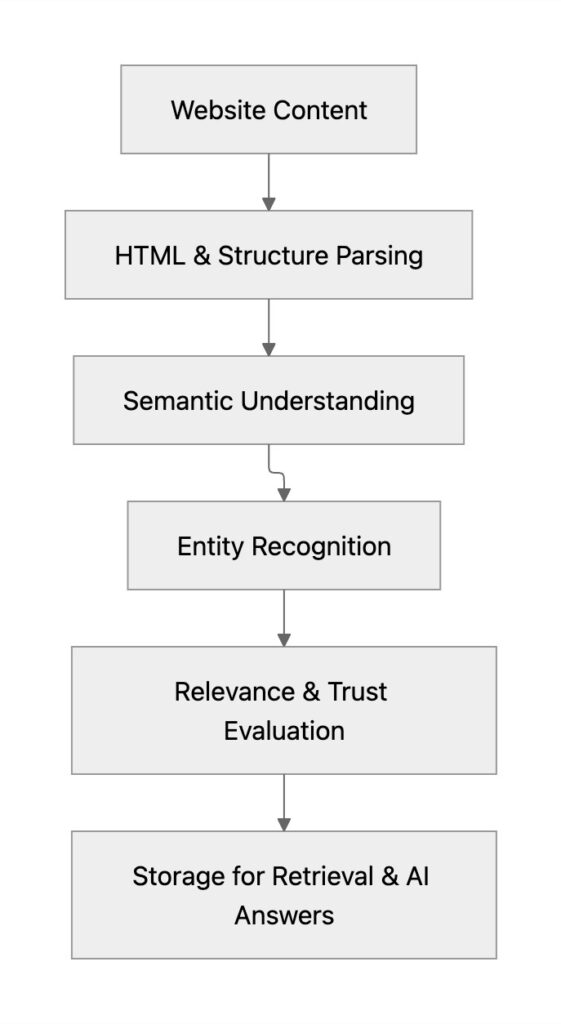
AI systems do not simply read pages — they interpret meaning and credibility signals before retrieval.
Why AI Interpretation Matters for Search Visibility
In AI-driven search environments, visibility depends on whether AI systems can:
- understand your content
- recognize your expertise
- trust your information
- retrieve it confidently
If your content is unclear or poorly structured, it may be ignored — even if it ranks in traditional search.
Key Elements AI Crawlers Analyze
1. Page Structure & HTML Clarity
AI systems rely on clean HTML structure to interpret content hierarchy.
They evaluate:
- heading hierarchy (H1 → H2 → H3)
- semantic HTML usage
- logical content structure
- navigation and internal linking
A clean structure improves machine readability and comprehension.
Best Practices
- One clear H1 per page
- Organised subheadings
- Use semantic tags (article, section, nav)
- Avoid cluttered layouts
2. Semantic Meaning & Context
AI models interpret content based on context and relationships between ideas.
They evaluate:
- topic relevance
- user intent alignment
- contextual clarity
- depth of explanation
Content written with clarity and context improves retrieval accuracy.
Example
- Weak: “We offer solutions for businesses.”
- Strong: “We provide digital payment solutions for small businesses in India.”
Clear context improves AI understanding.
3. Entity Recognition
AI systems identify and map entities to knowledge graphs.
Entities include:
- brand names
- products and services
- locations
- organizations
- industry terminology
Consistent naming and context strengthen entity recognition.
4. Structured Data & Schema Markup
Structured data helps AI systems interpret your content more precisely.
Schema markup clarifies:
- organization details
- services and products
- FAQs and reviews
- articles and authors
- local business information
This improves clarity and citation potential.
5. Internal Linking & Content Relationships
AI crawlers analyze internal links to understand:
- content hierarchy
- topical depth
- relationships between subjects
Strong internal linking strengthens topical authority.
Traditional Crawling vs AI Interpretation
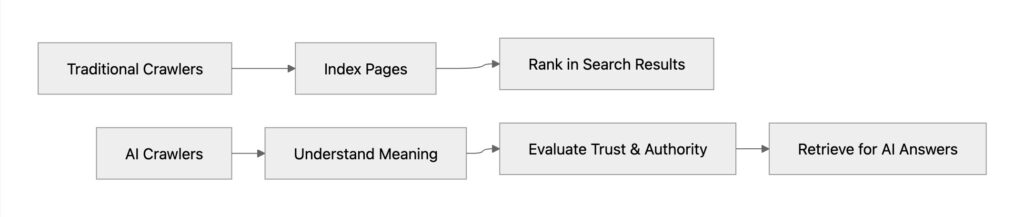
Traditional search indexes pages.
AI systems evaluate meaning and trust before retrieval.
How AI Evaluates Trust & Authority
AI systems assess credibility using multiple signals:
| Trust Signal | What AI Evaluates |
|---|---|
| Content depth | expertise & accuracy |
| Brand consistency | identity reliability |
| Citations & mentions | external validation |
| Structured data | clarity & credibility |
| Internal linking | topical authority |
Trust determines whether content is retrieved for AI answers.
Common Issues That Prevent AI Understanding
Even high-quality content may be ignored if technical clarity is poor.
Frequent Problems
- cluttered or inconsistent HTML structure
- missing headings or poor hierarchy
- thin or vague content
- lack of structured data
- inconsistent brand naming
- broken internal linking
- outdated or conflicting information
These issues reduce retrieval and citation likelihood.
Signs Your Website Is Hard for AI to Interpret
- AI answers never cite your content
- competitors appear in AI results instead
- knowledge panels lack your brand
- inconsistent brand mentions across platforms
- These signals suggest weak AI interpretability.
How to Optimize Your Website for AI Crawlers
Use Semantic HTML Structure
Maintain proper heading hierarchy and clean markup.
Write Clear, Context-Rich Content
Avoid vague language and ensure topical clarity.
Implement Structured Data
Use schema markup to improve entity understanding.
Maintain Consistent Brand Terminologies
Ensure consistent naming across pages and platforms.
Strengthen Internal Linking
Connect related content to build topical relationships.
Improve Content Depth & Clarity
Provide comprehensive explanations and examples.
AI Interpretation Optimization Checklist
| Optimization Area | Action | Impact |
|---|---|---|
| HTML structure | Use semantic markup | High |
| Content clarity | Add context & depth | High |
| Schema markup | Implement structured data | High |
| Brand consistency | Standardize naming | Medium |
| Internal linking | Connect related pages | High |
| Entity signals | Reinforce expertise topics | High |
Role of an LLM Audit in AI Crawl Optimization
An LLM audit evaluates how AI systems interpret and retrieve your content.
It helps identify:
- structural clarity issues
- entity recognition accuracy
- semantic coverage gaps
- trust & authority weaknesses
- retrieval readiness problems
Regular audits ensure your site is understandable and retrievable by AI systems.
How an LLM Audit Improves AI Interpretation
An audit strengthens your AI visibility by:
- detecting structural problems affecting parsing
- improving entity clarity and recognition
- identifying missing schema markup
- highlighting weak topical coverage
- strengthening trust and retrieval signals
This ensures AI systems can confidently interpret and cite your content.
AI Interpretation Signal Flow

Each step strengthens visibility in AI search environments.
Future of AI Crawling & Search
AI search is evolving toward:
- conversational answers
- entity-driven retrieval
- contextual understanding
- trust-based ranking
Websites optimized for AI interpretation will have a strong advantage.
Final Insight
AI crawlers do more than scan pages — they interpret meaning, relationships, and trust signals.
If your website is structured clearly and communicates context effectively, it becomes easier for AI systems to retrieve and cite your content.
Optimizing for AI interpretation ensures your content remains visible in the evolving AI search ecosystem.
AI visibility is no longer just about ranking — it is about being understood.