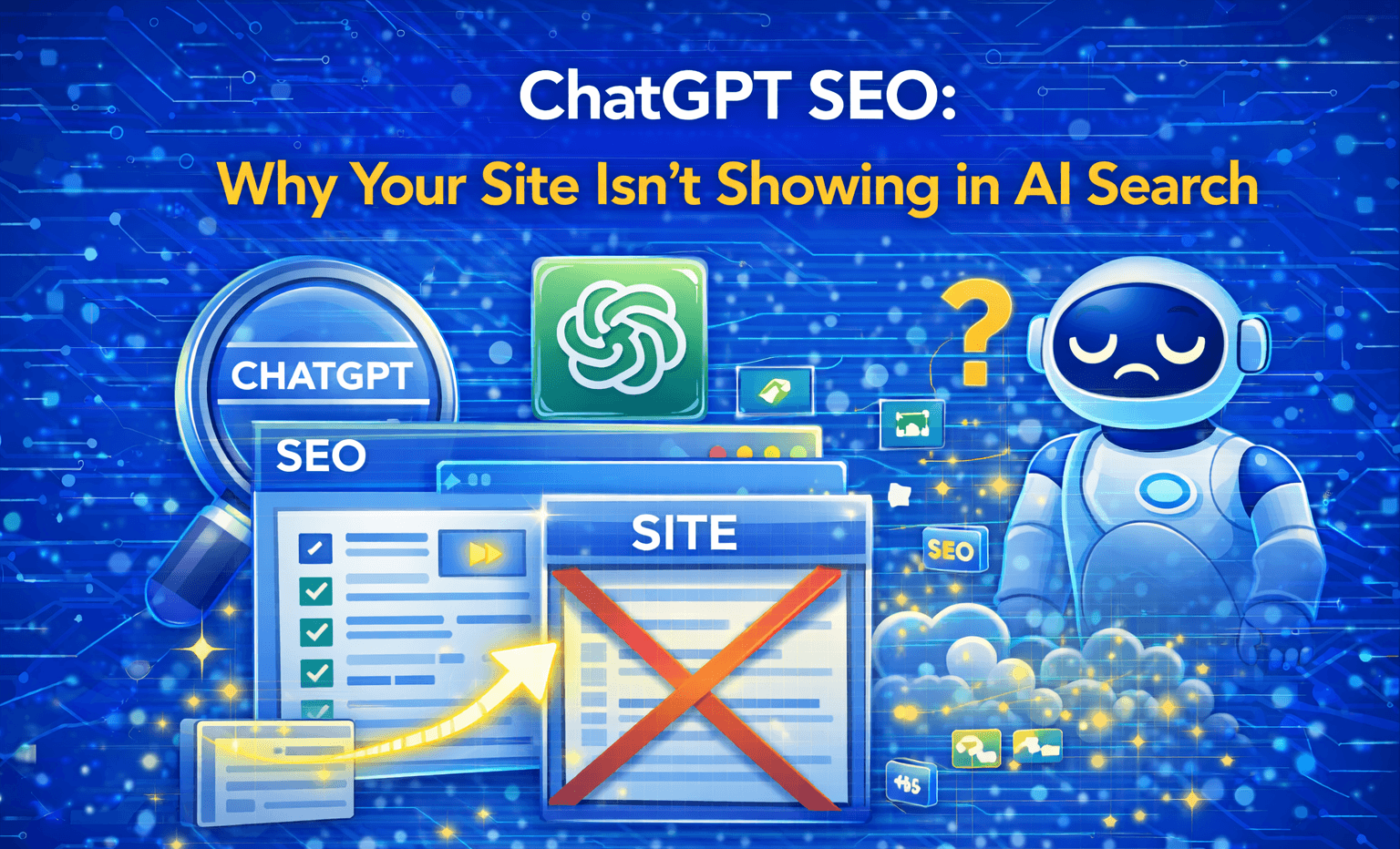
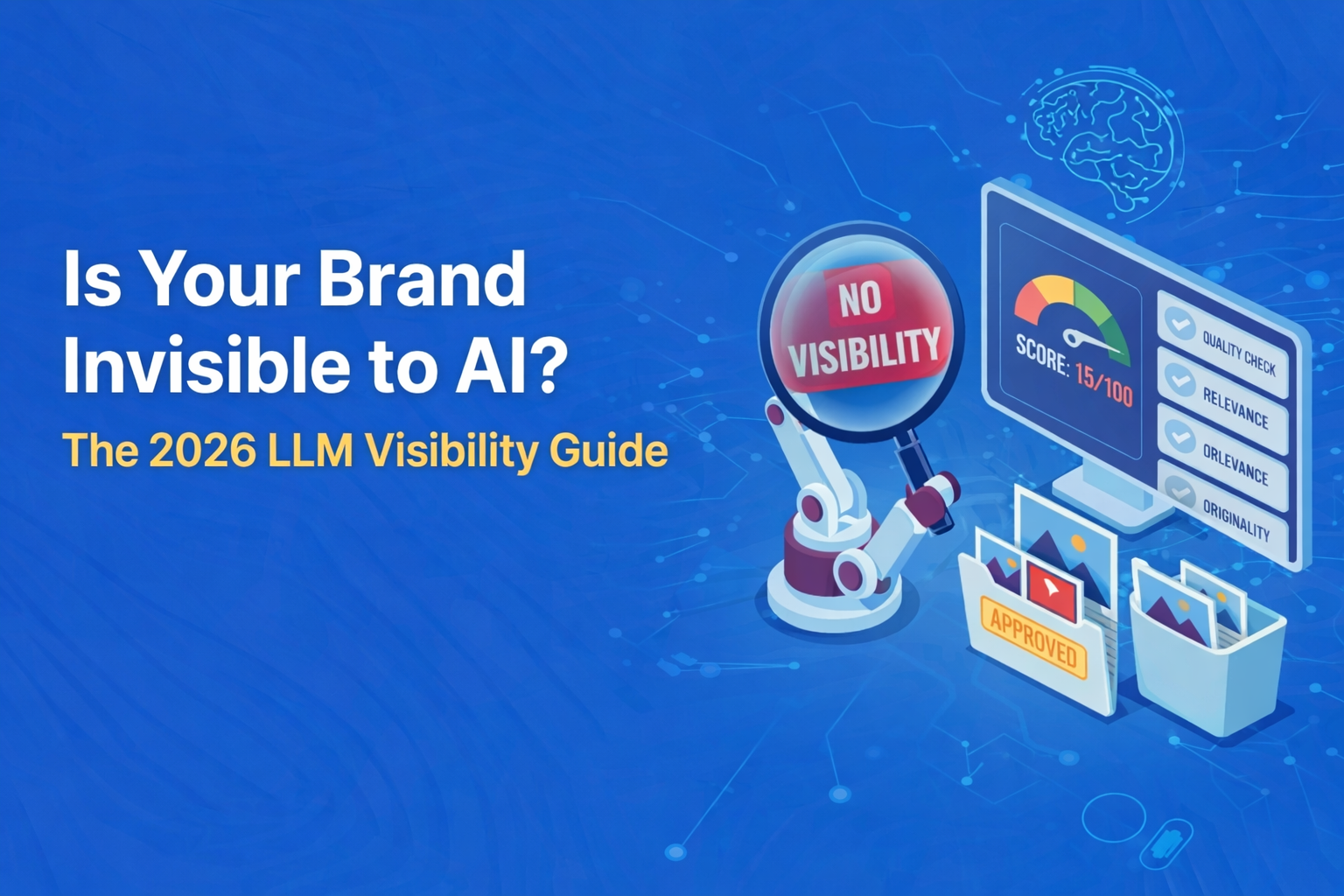
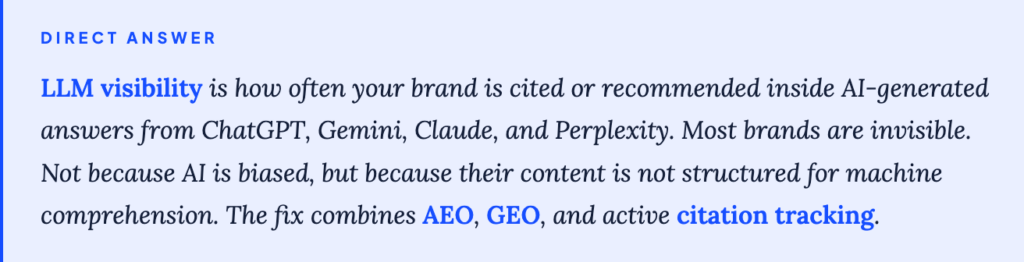
Most brands assume that if they rank on Google, they exist in AI. They don’t. Here’s what LLM visibility actually means and how to start building it.
Why LLM Visibility Matters More Than SEO in 2026
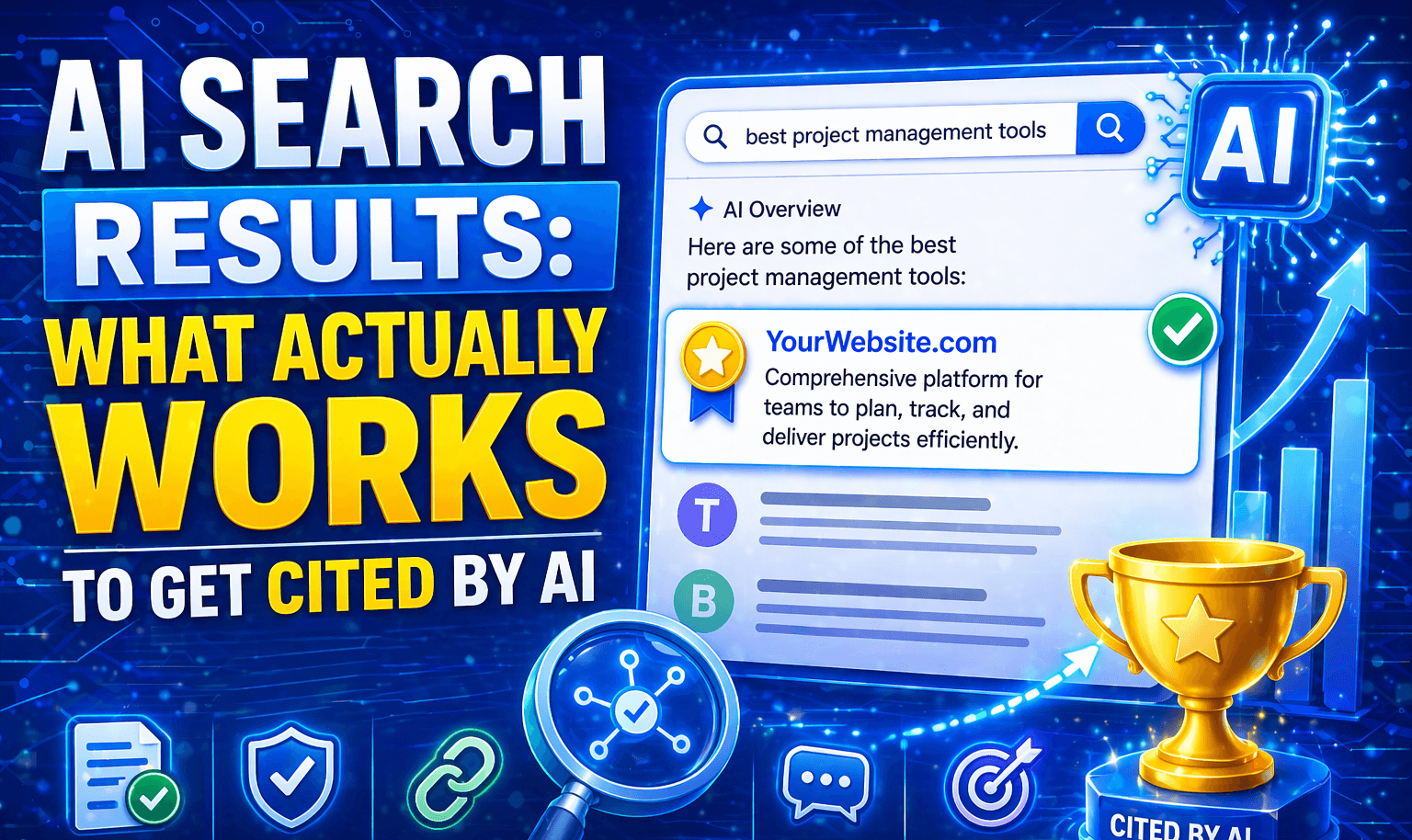
Search behavior has changed dramatically. Today, many users especially in B2B and high-consideration categories, start their research on AI platforms like ChatGPT or Perplexity instead of Google. Unlike traditional search engines, these systems don’t show ten blue links. Instead, they provide one clear answer. Sometimes, they include two or three sources.
Therefore, if your brand isn’t mentioned, you effectively don’t exist at that moment.
However, this doesn’t mean SEO is dead. Instead, a new parallel system has emerged. It follows different rules, uses different signals, and currently has far less competition. As a result, brands that act early can dominate visibility—just like early SEO adopters did years ago.
Moreover, recent studies show that most B2B buyers now use AI tools during their decision-making process. In addition, users trust brands more when AI mentions them directly. Yet surprisingly, most companies still lack a strategy for this shift.
Clearly, this gap presents a major opportunity.
AEO vs. GEO vs. Traditional SEO
These three terms get conflated constantly. They shouldn’t be. Each targets a different system with different mechanics.
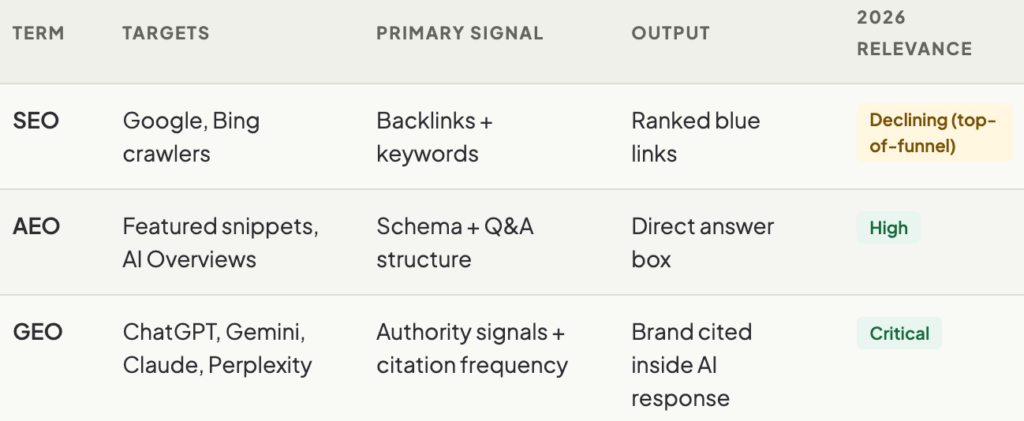
The right mental model: SEO gets you indexed. AEO gets you extracted. GEO gets you cited inside the AI’s answer. They’re stacked layers, not alternatives. Most brands are only playing the first layer.
How AI Models Decide Which Brands to Mention
LLMs don’t crawl the web in real time (except when using search plugins like Perplexity or ChatGPT Browse). Their foundational knowledge is built from training data, a snapshot of the internet. How often your brand appears in that snapshot, and from which sources, shapes your citation baseline. For retrieval-augmented models, fresh web authority also kicks in at query time.
The six signals that matter most:
- 1 Training data frequency: how many credible web sources mention your brand. Volume and source quality both count.
- 2 Structured content clarity: FAQ sections, comparison tables, definition boxes. AI models extract structured answers far more readily than flowing prose.
- 3 Third-party citations: mentions on Reddit, G2, Trustpilot, Product Hunt, and industry publications increase training data presence and retrieval authority.
- 4 Schema markup (JSON-LD):
FAQPage,HowTo,Article, andOrganizationschema tell AI systems exactly what your content is about, without inference. - 5 Topical authority depth: owning a topic with 10–20 interlinked, comprehensive pieces signals category expertise to both search crawlers and LLM training pipelines.
- 6 Sentiment framing: consistent positive framing across reviews, press, and UGC increases the probability of being cited favorably. AI inherits the tone of its sources.
How to Audit Your LLM Visibility Right Now
An LLM visibility audit answers three questions: Does AI mention you? In what context? Is the framing accurate and positive? Here’s the exact process:
- Define your target queries List 15–20 questions your ideal customers ask AI. Think: “What is the best [category] tool for [use case]?” and “Compare [you] vs [competitor].”
- Run prompts across all major LLMs Test ChatGPT (GPT-4o), Gemini 1.5 Pro, Claude 3.5, and Perplexity. Each has different training data and retrieval logic, so results vary significantly across platforms.
- Record citation presence, position, and sentiment Was your brand mentioned at all? First, second, or third? Did the AI recommend you, mention you neutrally, or associate you with a negative frame?
- Benchmark against competitors Run the same prompts for your top competitors. Map the citation gap. This is your opportunity surface.
- Track weekly, not once LLM models update. One-time audits go stale fast. Automate weekly citation scans to catch shifts before they cost you pipeline.

See Where You Stand in 60 Seconds
LLMAudit.ai runs automated citation audits across ChatGPT, Gemini, Claude, and Perplexity.
Start Your Free LLM Audit →What to Do This Week
Most brands can meaningfully improve their citation rate within 30–60 days by focusing on high-leverage, low-effort actions first.
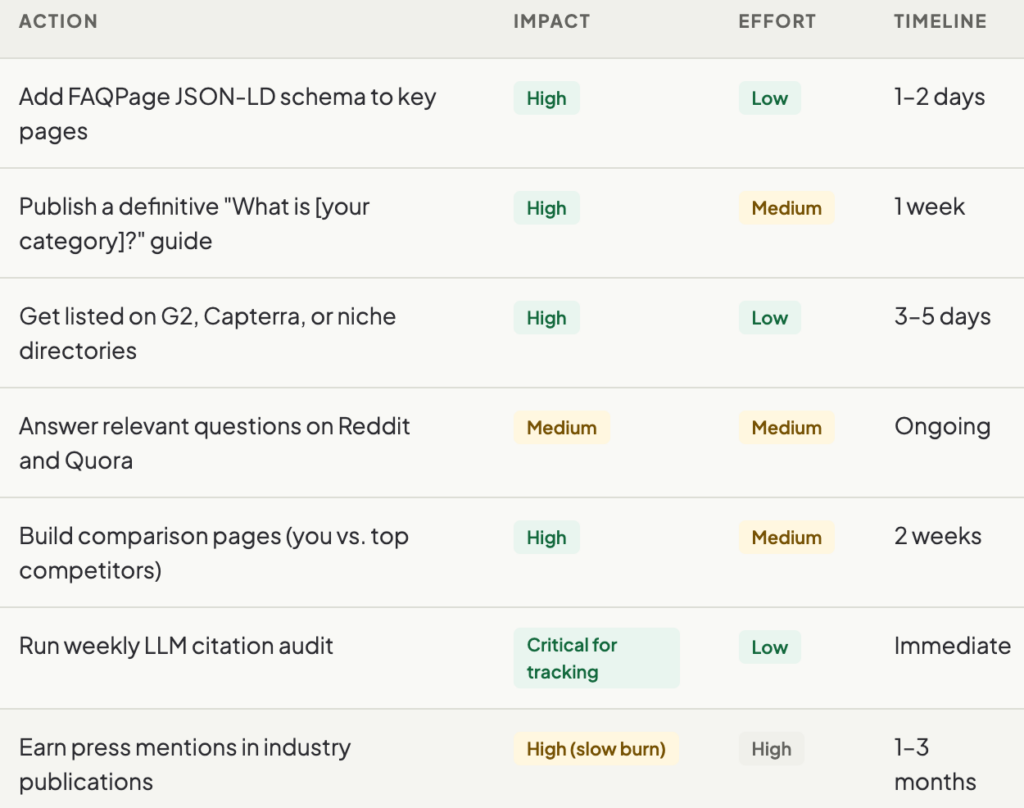
The pattern holds: structural fixes deliver fast wins. Content depth and third-party authority compound slowly but have the highest ceiling. Do both in parallel.