The promise of AI traffic and why it rarely delivers
Marketers everywhere are chasing the promise of an AI traffic generator. The idea seems simple: if users are moving from traditional search engines to ChatGPT, Perplexity, Gemini, and other AI tools, shouldn’t your content get more traffic too? On paper, yes. In reality, it rarely works the way you expect.
Even the best AI traffic generators struggle to deliver meaningful results. You might optimise endlessly, try AI SEO tools, experiment with structured formats, or use a keyword research tool to target AI-driven searches, but your traffic often stays flat. Leads don’t increase, analytics show no growth, and it can feel like your content is performing somewhere in the background, yet you have no visibility.
Why AI has broken the traditional SEO loop
The reason is straightforward: the way people discover information has fundamentally changed. Traditional SEO operated on a loop: rank higher – get clicks – generate traffic – create value. AI traffic generators break that loop entirely.
When a user interacts with ChatGPT or any conversational AI search tool, they aren’t browsing multiple links; they want a single, clear answer. Once the answer is delivered, the journey stops. There’s no clicking, no site visits, no measurable traffic.
Your content might already be shaping AI-generated answers, but your brand doesn’t appear, users never click your link, and your analytics show nothing.
Yet your content might already be shaping that AI-generated answer. The way you structure ideas, the depth of your insights, even your phrasing, all of it can contribute to AI content that feeds into generative responses. The catch? Your brand doesn’t appear. Users never click your link. Your analytics dashboards show nothing. Meanwhile, competitors may surface instead, even if their content isn’t better, just more “AI-friendly.”
The blind spot between traditional SEO and AI visibility
Most analytics tools aren’t designed to detect this. They measure visits, conversions, or clicks, t not AI search visibility. They can’t show when your content was surfaced in an AI-generated answer, when your brand was cited, or when a competitor dominated a query. That’s the blind spot where traditional SEO and AI for SEO collide.
The core problem: You’re investing in content, optimising for search, and running audits, but you have no visibility into whether any of it is showing up inside the AI tools where your audience is actually searching.
How LLMAudit closes the visibility gap
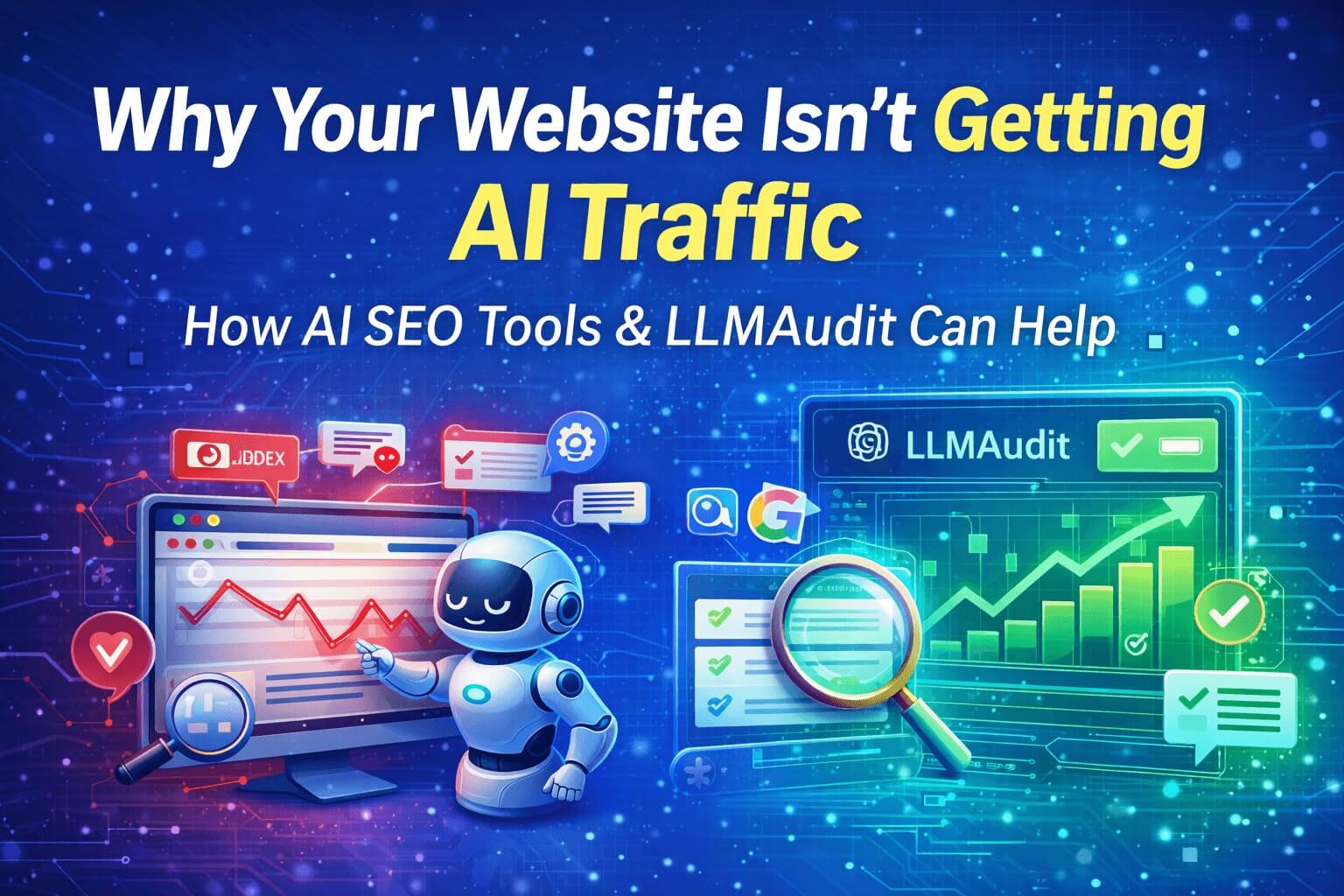
This is where LLMAudit becomes indispensable. Instead of guessing which content is being used, LLMAudit gives you a clear view of what’s happening inside AI tools. It tracks where your content appears, which queries surface your brand, and how your visibility stacks up against competitors. It even highlights why some content is favoured over others in AI searches.
With LLMAudit, your approach shifts from assumption to insight. You can see which pages are contributing to AI answers, refine content that isn’t performing, and measure your AI content visibility. Combining this with smart SEO practices and SEO audit tools, you can optimise for both human users and AI systems. The result? A strategy that actually works without relying on random chance or hope.
The right question to ask in 2026
The appeal of an AI traffic generator is clear; it promises results in a world where clicks used to define success. But in 2026, visibility inside AI systems comes before traffic. The right question is no longer “how do I get traffic from AI?” It’s “Am I even showing up where users are searching?”
When your content is recognised inside AI tools, you start building authority and visibility long before anyone clicks a link. That’s the advantage LLMAudit provides: actionable insight, AI SEO optimisation, and the ability to reclaim your brand presence in a world increasingly dominated by content AI.
A smarter approach to AI search visibility
If you’re serious about growth, relying solely on an AI traffic generator won’t cut it. Instead, combine AI for SEO, visibility insights, and structured content audits. With LLMAudit, you gain the clarity needed to measure, improve, and dominate AI search visibility before your competitors do.
In the age of answer-based search, the brands that show up first aren’t just lucky, they’re informed, optimised, and recognised. LLMAudit ensures your content counts where it matters most.
Find out if your brand is showing up in AI search
LLMAudit tracks your AI search visibility, identifies where competitors are appearing instead of you, and gives you actionable steps to fix it.
Start your free AI visibility audit –
FAQs
AI tools don’t show a list of links — they pick 2–3 brands and stop. If your brand lacks visibility signals outside your own website, AI tools skip you entirely. No click, no traffic, no credit.
Rarely. Because traffic from AI comes after visibility — not before. Until your brand is being recommended inside AI-generated answers, no AI traffic generator can fix that gap.
AI systems use your ideas and structure to generate answers, but only name brands with strong third-party mentions. You power the answer, your competitor gets the recognition.
Google rewards your content. AI tools reward what others say about you. Two different games — most brands are only playing one.
LLMAudit audits how your brand appears across AI-generated responses. It shows you which LLMAudit shows exactly where your brand appears in AI-generated answers, which competitors are taking your spot, and what to fix, giving you clarity that your current analytics tools can’t provide.