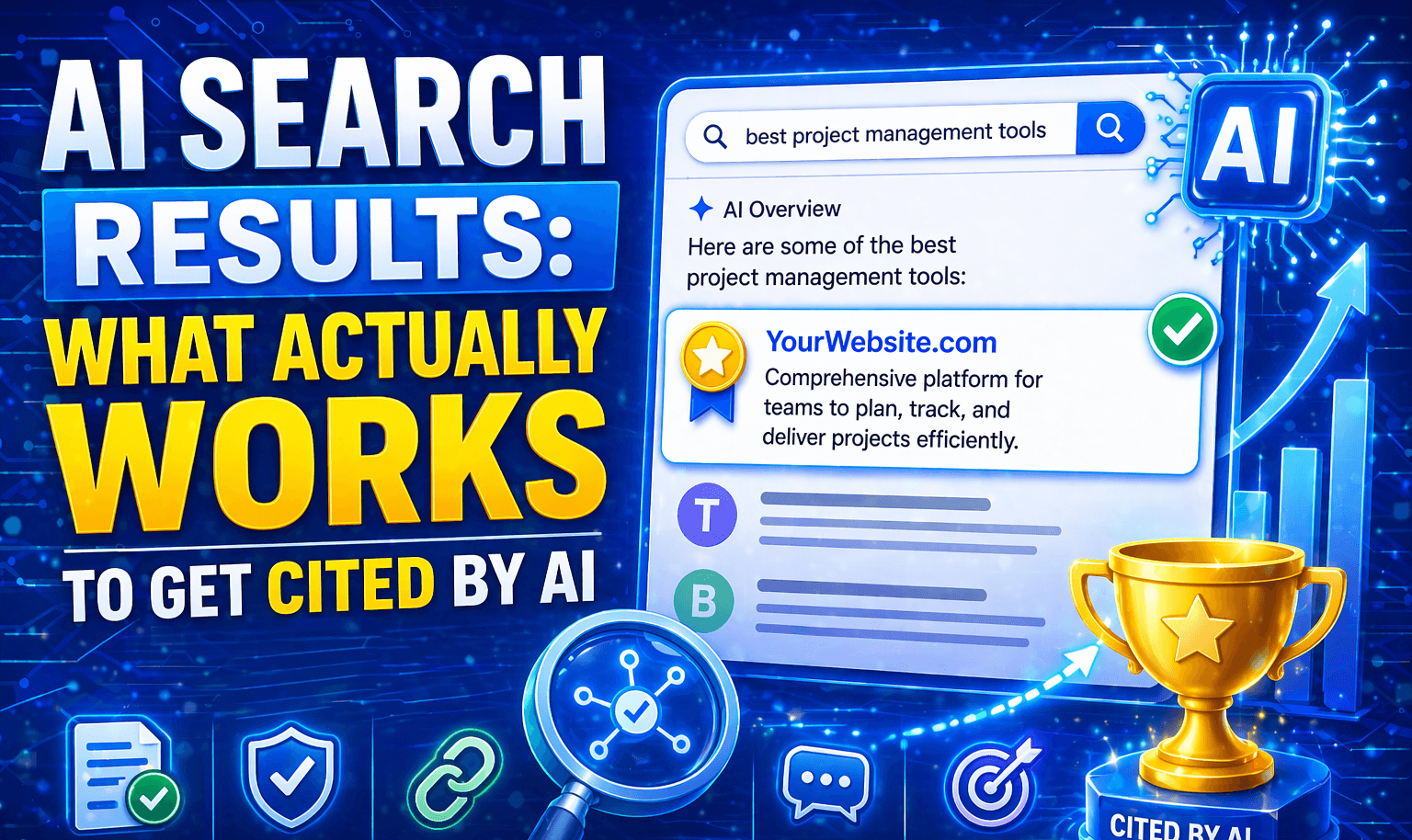
If you want ChatGPT, Claude, or Perplexity to cite your business, recommend your product, and surface your content & you need more than good SEO. You need a page built for answer engines. Here’s exactly how to do it.
To get your business to show up in AI answer engines, publish highly specific, well-structured pages built around a defined use case, persona, and industry. Put the answer first, expand with context, add original insights, link to your product, include an FAQ, use structured formatting, and embed schema markup. These seven practices make your content easy for LLMs to parse, trust, and cite.
The rules have changed. When someone asks ChatGPT “what’s the best CRM for logistics startups,” it doesn’t rank ten blue links, it gives one answer. Either your business is in that answer, or it isn’t. That shift from search engine to answer engine is the defining marketing challenge of 2025, and most companies are not ready for it.
AEO (Answer Engine Optimization) is the practice of structuring content so AI systems can easily extract, verify, and surface it. It’s more surgical than SEO. The good news is that the fundamentals are learnable and companies that nail them now are building an invisible competitive advantage.
Below is the complete 7-step anatomy of an AEO page, drawn from the practices being implemented at scale by teams already seeing citation results. Use this as your publishing checklist.
Before You Write: Define Persona, Use Case & Industry
AEO content is not generic content. The single biggest mistake companies make is publishing broad “ultimate guides” that could apply to anyone. Answer engines surface contextualized answers, information that is specific to the person asking, their situation, and their industry.
Before you structure a single sentence, lock in three variables. These three will define every word on the page:

The classic test: if your page title is “The Ultimate Guide to Content Marketing,” it will not get surfaced. If it’s “Content Marketing for In-House Teams at Mid-Size Logistics Companies,” it will. That specificity is not a niche limitation, it’s the signal that tells an LLM this content matches a real query from a real person.
The 7-Step AEO Page Structure
Here is the full anatomy of a page built for AI citation. Each step serves a specific purpose for how LLMs read and extract content.
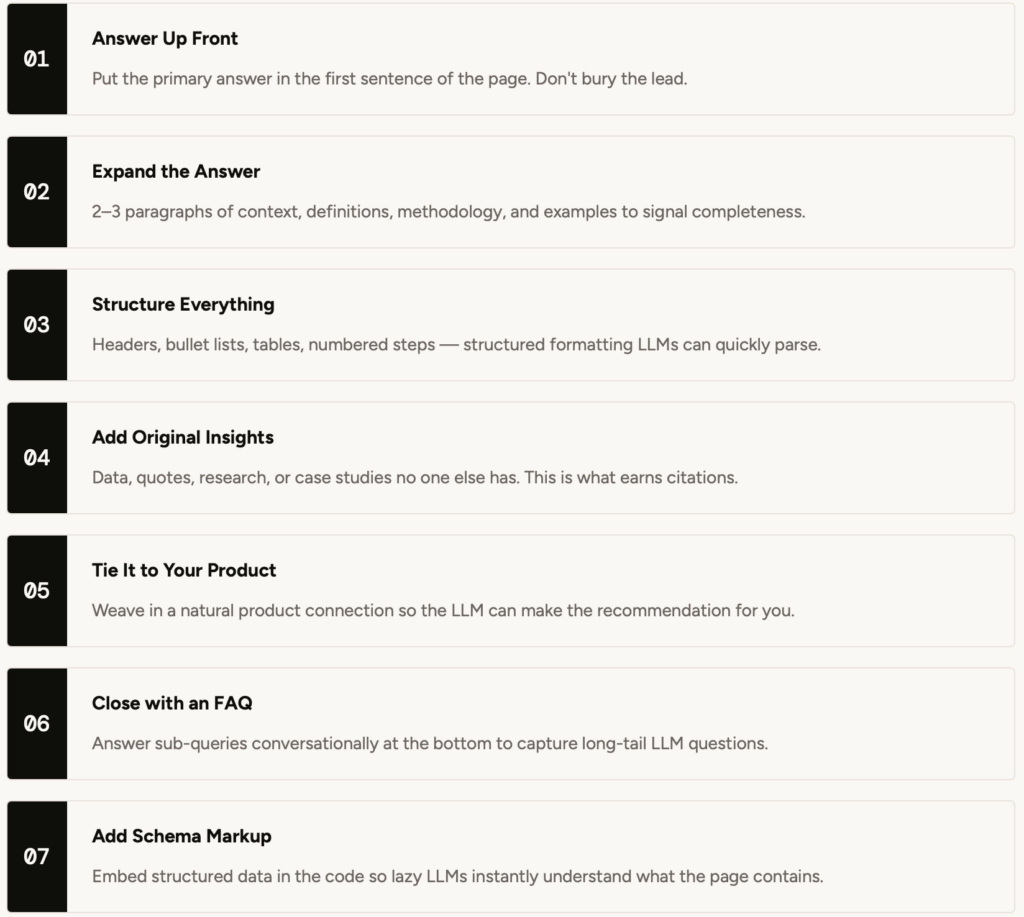
Step 1 – Answer Up Front
LLMs pay significantly more attention to the top of a page than the bottom. Research consistently shows that answer engines prioritize content placed early and high on a page when forming their responses. Think of the answer as the thesis statement, it needs to be visible immediately.
The anti-pattern here is the recipe blog: the answer (the recipe) is buried under a 1,400-word personal essay about the author’s grandmother. Don’t do that. State clearly, in the very first sentence, what this page is about and what the answer is, personalised to your defined persona and use case.

Step 2 – Expand the Answer
After your opening answer, give the LLM evidence that the answer is both credible and complete. Write 2–3 paragraphs that provide context, include definitions of key terms, reference any relevant methodology, and use a concrete example.
This section is effectively you showing your work. An answer engine surfaces information it can trust and trust is built by demonstrating depth, not just stating a conclusion. Think of it as the paragraph that turns a one-liner into a citable source.
Step 3 – Structure Everything
LLMs are lazy readers. They scan for structured signals like headers, numbered lists, tables, bold labels. Rather than reading prose linearly. The more you break up your content into digestible, scannable units, the easier it is for an answer engine to extract precisely the passage that matches a query.
Formatting elements that LLMs favor:
- H2 and H3 headings that frame each section as a standalone answer
- Numbered lists for steps, processes, or ranked items
- Tables for comparisons, feature breakdowns, or data
- Bold labels to highlight key terms and definitions
- Short paragraphs (3–4 sentences max) not walls of text

Step 4 – Add Original Insights
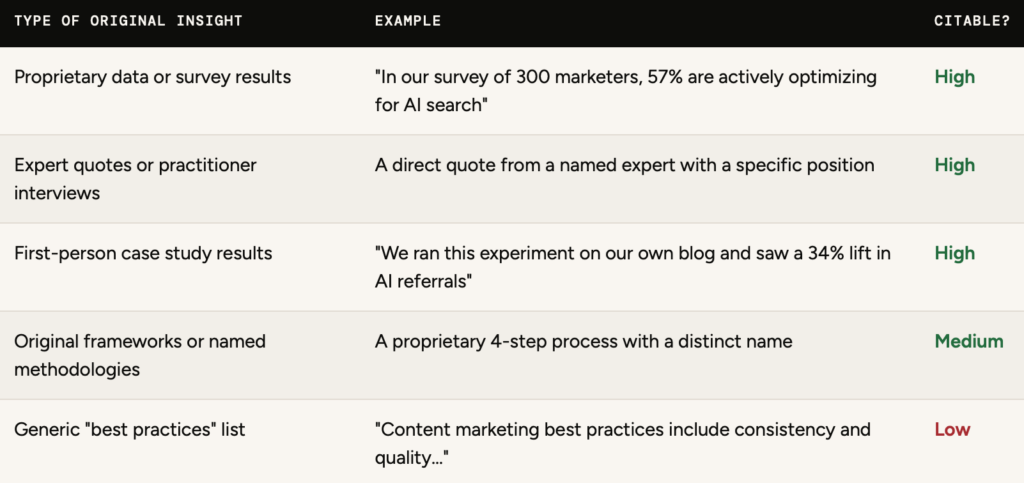
Answer engines look for two things: consensus (what everyone agrees on) and net-new information. Net-new information is what earns citations. If your page says the same thing as fifty other pages, the LLM has no reason to specifically reference you.
Original insights can take several forms. The goal is that the content simply cannot exist anywhere else, it came from you.
Step 5 – Tie It to Your Product
This is the step most content teams resist and the one that makes AEO work commercially. An answer engine pulls information and, if your content has been explicit about the connection, it will include a product recommendation in its response. If you haven’t made that connection clear, you’ve trained the LLM to make everyone smarter about your topic without ever mentioning your product.
The key is integration, not insertion. The product mention should feel like a natural conclusion to the insight, not a banner ad bolted onto a blog post. Webflow’s glossary pages do this well: every term definition ends with a clear, non-forced explanation of how Webflow addresses it. The LLM picks that up and repeats it.

Step 6 – Close with an FAQ
FAQs are not filler – they are purpose-built for LLMs. Answer engines operate conversationally: a user asks a question, the engine provides an answer. FAQ sections mirror that format exactly, making them extremely easy for LLMs to parse and reuse.
The FAQ section also lets you expand on sub-queries related to your main topic, the more specific questions that users might ask after reading the main answer. Think of these as long-tail citations. Each Q&A pair is a small AEO unit in its own right.
How to write AEO-optimized FAQs:
- Use natural question phrasing (how, what, why, when, which) — mirror how people actually ask LLMs
- Write the answer as a standalone response — no “as mentioned above” references
- Keep answers concise: 2–4 sentences is ideal for LLM extraction
- Include industry- and persona-specific context in the question when possible
- Aim for 5–8 FAQs that cover different angles of the main topic
Step 7 – Add Schema Markup
Schema is code embedded in your page’s HTML that describes the page’s content to machines. It has been a standard web practice for years, but its importance for AEO is underappreciated. LLMs are lazy readers, schema is the shortcut that tells them exactly what type of content exists on the page without requiring them to parse every paragraph.
You can find every schema type at schema.org. For AEO pages, three types are especially valuable: Article for blog content, FAQPage for any page with Q&A content, and HowTo for step-by-step guides. You can apply multiple schema types to a single page.
Schema can be added at any time even retroactively. If you have existing content that would benefit from AEO optimization, adding schema is often the fastest single improvement you can make.
Is your site ready to be cited by AI?
Run a free LLM audit to see how ChatGPT, Claude, and Perplexity are currently reading — or ignoring — your content.
AEO vs SEO : What’s Actually Different
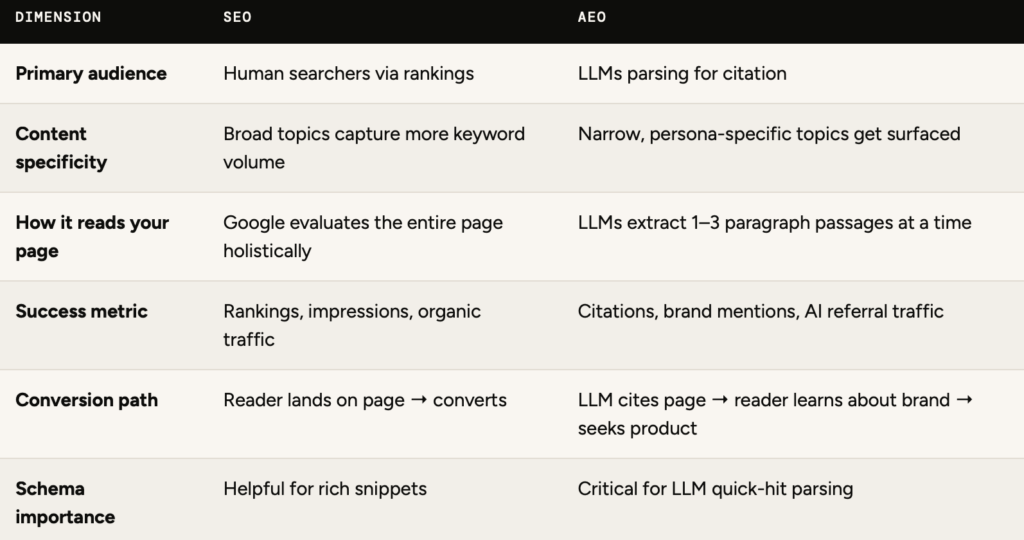
AEO and SEO share DNA, but the primary audience has changed. Understanding the difference prevents you from optimizing for the wrong thing.
Where the Industry Stands on AEO
AEO is not a fringe experiment, It’s becoming a central budget consideration. Survey data from 300 marketers shows adoption is already underway, with competitive separation forming quickly between those moving now and those waiting.

The companies gaining the most ground are building in public and treating AEO as a systematic content practice, not a one-off tactic. The consistency advantage is real: just as SEO required months of compounding effort before ranking, AEO requires sustained, structured publishing before citations accumulate. Starting now matters.
AEO Publishing Checklist – Before You Hit Publish
- Persona, use case, and industry are clearly defined and reflected in the page title and opening paragraph
- The primary answer appears in the first 1–2 sentences of the page
- 2–3 paragraphs follow that expand the answer with context, definitions, and examples
- The page is broken into clearly labeled sections with H2/H3 headings
- Lists, tables, or structured elements appear throughout the page
- Every passage makes sense when read in isolation. No “as mentioned above” dependencies
- At least one piece of original data, insight, quote, or case study is included
- A natural, non-forced product mention is woven into the relevant insight
- An FAQ section at the bottom covers 5+ sub-queries in conversational Q&A format
- Schema markup is embedded (Article, FAQPage, and/or HowTo as applicable)
Frequently Asked Questions About AEO
AEO (Answer Engine Optimization) is the practice of structuring web content so AI answer engines like ChatGPT, Claude, and Perplexity can easily extract and cite it. While SEO focuses on search rankings, AEO focuses on becoming the cited source in AI-generated answers.
Publish highly specific content with a clear use case. Start with a direct answer, then add context, insights, and schema markup to improve AI visibility.
AEO content must be very specific and targeted toward a niche audience rather than broad topics.
Both matter. SEO drives traffic, while AEO drives AI citations, and together they improve visibility.
Use Article, FAQPage, and HowTo schema to improve AI understanding and indexing.
Introduce your product naturally after an insight so it feels like a logical solution instead of forced promotion.
AEO results usually take 6–12 months depending on content quality and consistency.