For over two decades, Search Engine Optimization has been built around a single core idea: make Google rank your page higher than everyone else’s. Stuff the right keywords in the right places, earn enough backlinks, and watch the traffic flow in. It was a game of placement — a race to page one.
That game is still being played. But a new game has started alongside it — one with different rules, different winners, and a completely different definition of what it means to be “found.”
Welcome to the era of Generative Engine Optimization (GEO), where the goal isn’t to rank on a list. It’s to become the answer itself.
The Old World: How Traditional SEO Worked
Traditional SEO was fundamentally about signals. Search engines like Google crawled web pages, indexed content, and used hundreds of ranking factors — keyword relevance, domain authority, page speed, backlinks, structured data — to decide which pages to surface for a given query.
The relationship between a website and a search engine was transactional. You optimised for the algorithm, the algorithm rewarded you with a position, and users clicked through to your site. Traffic was the metric that mattered.
In traditional SEO, your content competes for a position on a page that users still have to click through. In AI search, your content either becomes part of the answer — or it doesn’t exist.
The entire ecosystem of SEO tools, agencies, and strategies was built around this model: rank tracking, keyword density, meta tag optimization, link building campaigns. These still matter. But they are no longer sufficient.
The New World: How AI Search Works
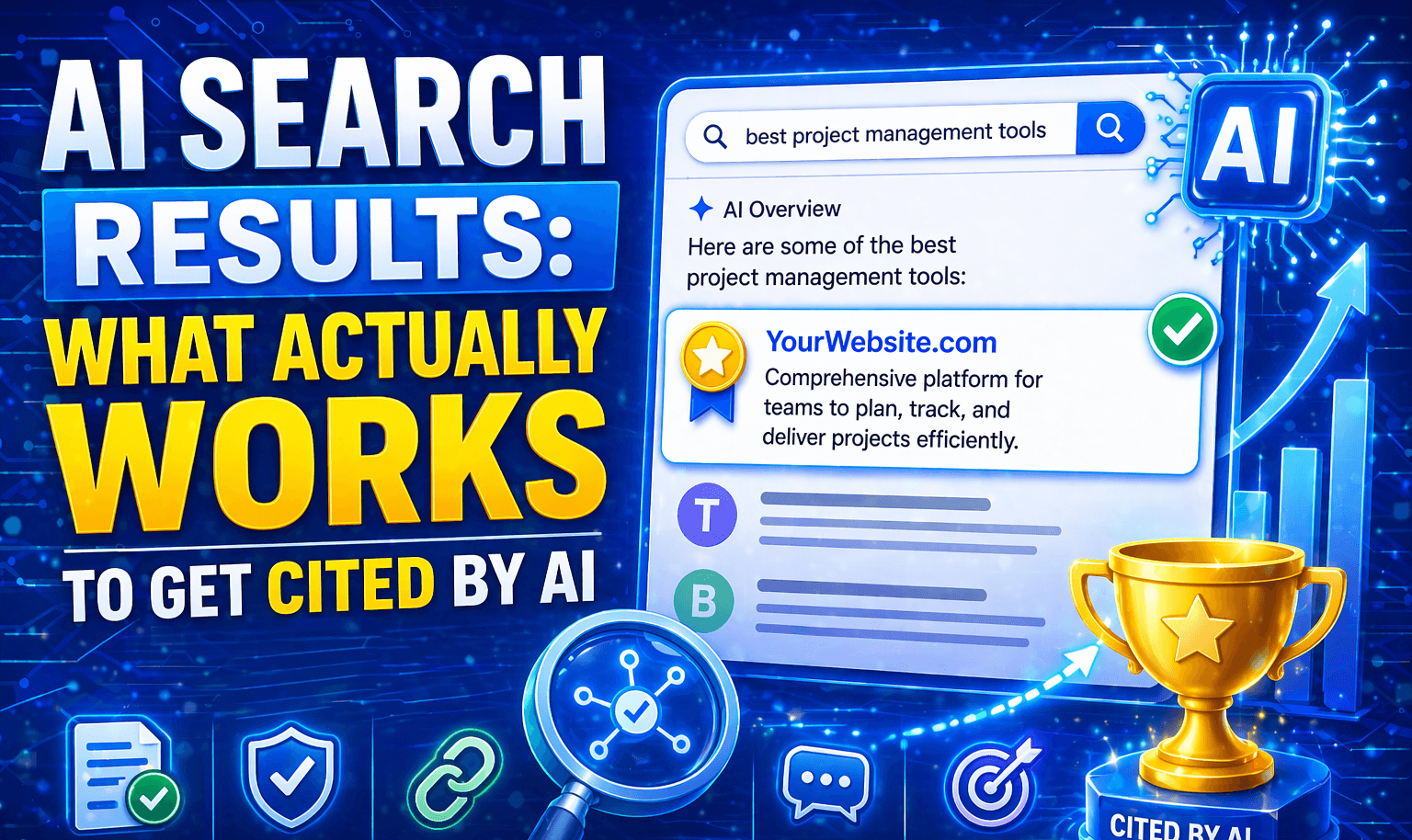
AI-powered search engines — Google’s AI Overviews, ChatGPT Search, Perplexity AI, and Microsoft Copilot — don’t return a list of links and ask users to choose. They synthesize information from multiple sources and deliver a direct, conversational answer.
Instead of competing for position one on a ten-result page, you’re now competing to be one of a handful of sources that an AI model deems credible, relevant, and trustworthy enough to cite — or to inform its answer without citing at all.
This is not an evolution of SEO. It is a parallel discipline with different mechanics.
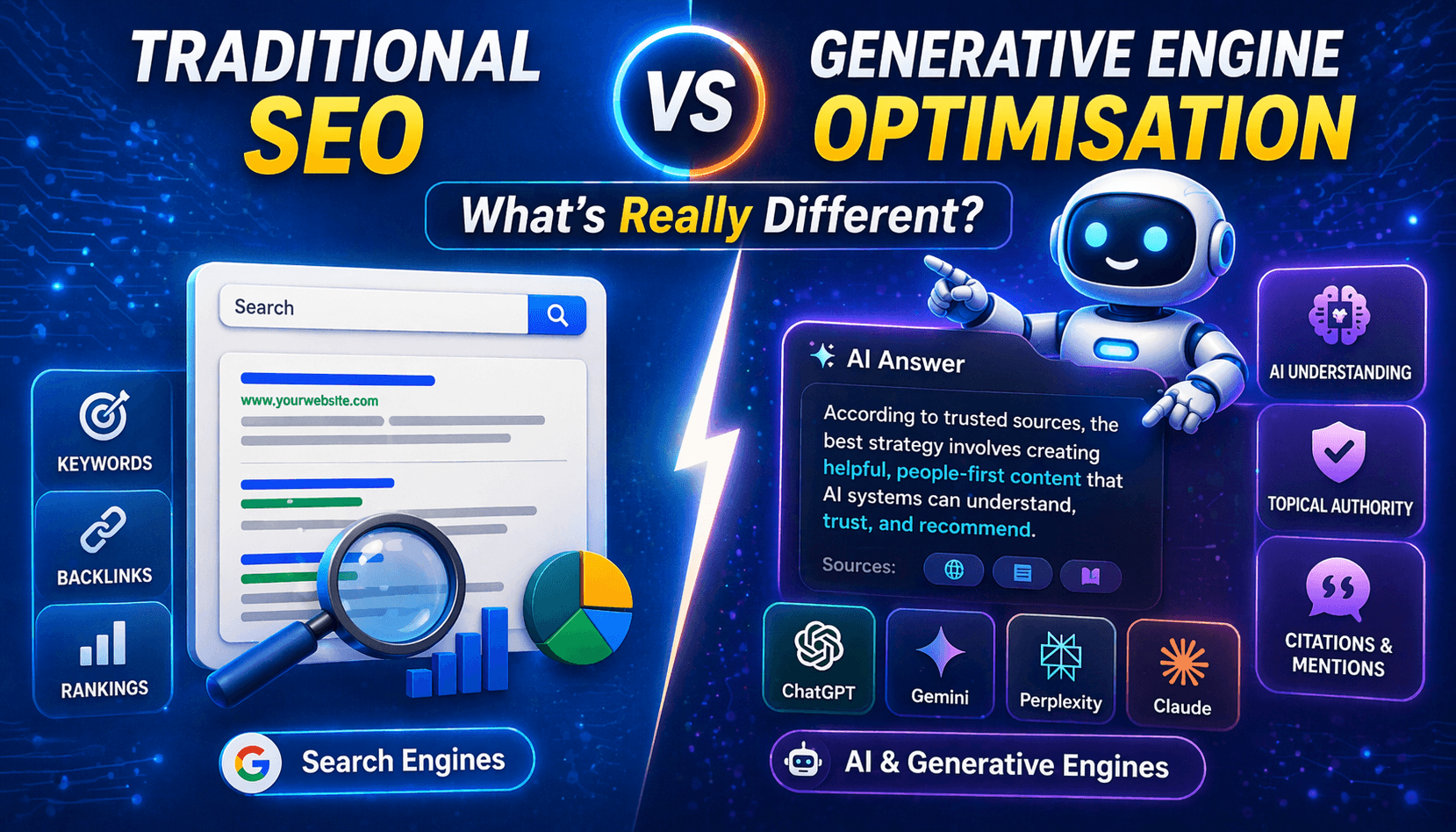
Traditional SEO vs Generative Engine Optimisation
| Factor | Traditional SEO | AI / GEO |
| Output | Ranked list of pages | Direct synthesized answer |
| User Action | User clicks through | Zero-click — answer shown inline |
| Success Metric | Position + click-through rate | Citation or brand mention in AI output |
| Ranking Signal | Keywords + backlinks | Trust, E-E-A-T, semantic relevance |
| Content Format | Keyword-optimized pages | Conversational, question-structured |
| Authority Signal | Domain authority + links | Author credibility + brand mentions |
| Content Strategy | Volume + keyword coverage | Depth, clarity, and original insight |
5 Core Differences That Matter
1. Intent vs. Query Matching
Traditional SEO optimizes for keywords. AI search engines interpret intent. They understand that the user wants a recommendation, not a page stuffed with shoe-related keywords, and they seek out content that genuinely addresses the underlying need with expertise and clarity.
2. Authority Is Measured Differently
In traditional SEO, authority is largely a function of backlinks. In AI search, authority is more holistic. It factors in E-E-A-T (Experience, Expertise, Authoritativeness, Trustworthiness), the credibility of named authors, original research, citations from recognized institutions, and the consistency of your brand’s presence across the web.
3. Zero-Click Is the New Norm
Traditional SEO measured success in organic click-through rates. AI search introduces a new reality: zero-click visibility. Your content might inform an AI-generated answer that thousands of users read — without a single person ever visiting your website. This forces a rethink of how we measure ROI from search presence.
4. Content Structure Matters More Than Ever
AI models favor content that is clearly structured, factually precise, and written to directly address questions. Long-form, meandering content that buries the answer in paragraph seven performs poorly in AI retrieval. FAQ formats, clear headings, concise definitions, and content that mirrors conversational queries are rewarded.
5. Brand Mentions Replace Backlinks
Being mentioned positively across forums, review sites like reddit.com, social media, and authoritative publications — even without a hyperlink — contributes to your brand’s perceived authority. AI models are trained on vast corpora of web text, and consistent, positive brand mentions teach these models to associate your brand with credibility in a given topic area.
Does Traditional SEO Still Matter?
Absolutely — but with an important caveat. Traditional SEO and GEO are not mutually exclusive. A strong foundation of technical SEO (site speed, crawlability, schema markup, mobile optimization) still matters because AI search engines still index and crawl the web.
Think of traditional SEO as the foundation and GEO as the architecture built on top. You can’t skip the foundation, but the building that matters most is what comes after.
The mistake is treating them as the same discipline. Optimizing purely for traditional ranking signals while ignoring AI-specific factors — trust, depth, conversational clarity, brand reputation — will leave you invisible in the fastest-growing search surfaces of the next decade.
Where to Start with GEO
If you’re just beginning to think about AI search visibility, three areas offer the highest leverage:
Audit
Audit your content for conversational clarity. Rewrite key pages so the most important answer appears in the first two sentences. Use FAQ sections. Structure content around specific questions people actually ask.
Author authority
Invest in author authority. Make sure content is attributed to real experts with verifiable credentials. Build author bio pages. Publish original data and research that other sites will cite.
Off-site brand presence
Expand your off-site brand presence. Get mentioned in industry publications, podcasts, review platforms, and forums. Each mention is a data point that AI models use to assess your credibility.
Know more about GEO : AI SEO Optimization
Generative Engine Optimisation (GEO) is the practice of optimising your content to appear in AI-generated search answers — such as Google AI Overviews, ChatGPT Search, and Perplexity AI responses. Unlike traditional SEO, which aims to rank your page in a list of results, GEO focuses on making your brand the trusted source that AI models cite, reference, or use to synthesize answers.
Yes — traditional SEO remains relevant and provides the technical foundation that AI search engines still rely on. Site speed, crawlability, schema markup, and backlink authority all continue to influence how AI models discover and evaluate content. However, traditional SEO alone is no longer sufficient.
Currently, tracking AI search visibility is more complex than monitoring keyword rankings. You can manually test by searching your target queries on ChatGPT, Perplexity AI, and Google’s AI Overview to see if your brand is cited or referenced.
GEO is a long-term strategy, much like traditional SEO. Building the trust signals, author authority, and brand presence that AI models recognise takes time — typically three to six months before measurable improvements appear. Content that is clearly structured, factually rich, and directly answers specific questions tends to gain AI visibility faster than generic articles.