You already know how SEO works. Keywords, backlinks, rankings — the fundamentals haven’t disappeared. But if your strategy stops there, a large and growing portion of search is leaving you behind.
While 94% of brands invest heavily in traditional SEO, 62% are technically invisible to generative AI models. That’s not a minor gap. It’s a strategic blind spot.
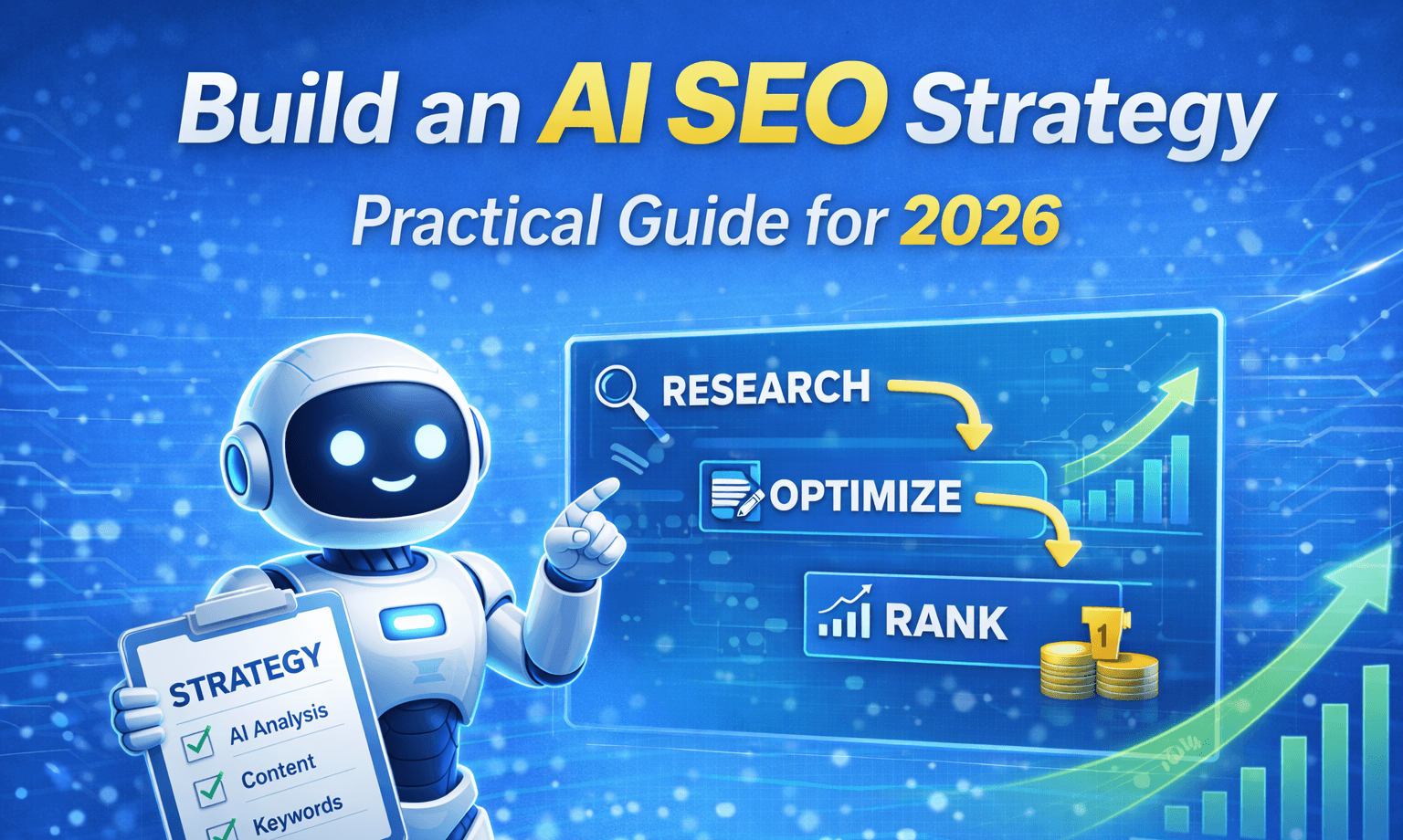
In 2026, a complete AI SEO strategy means optimizing for two things at once: ranking on Google and getting cited inside AI-generated answers. This guide shows you exactly how to do both.
Why Your Existing SEO Strategy Isn’t Enough
If you’re already doing SEO, you have a head start. However, the way users find information has fundamentally shifted.
Around 93% of AI Mode searches end without a click. Moreover, 60% of all searches in 2026 end without the user clicking any link at all. That means even well-ranked content is losing its audience to AI-generated answers.
The result is that traditional rankings no longer guarantee visibility. Therefore, your AI SEO strategy needs a second layer — one built specifically for how AI systems select and cite content.
The Two Layers of a Modern AI SEO Strategy
Think of it as a two-floor building.
Floor 1 — Traditional SEO (still essential) Traditional SEO is still the foundation. 76.1% of URLs cited in AI Overviews also rank in Google’s top 10. So ranking well remains a prerequisite for being cited by AI. Keep doing keyword research, building authority, and maintaining technical health.
Floor 2 — AI Optimization (the new layer) Once you rank, the next challenge is getting cited. This is where most teams currently have zero strategy. AI systems don’t reward keyword density — they reward clarity, structure, and factual depth. Your AI SEO strategy needs to address both floors to succeed.
6 Tactics That Should Be in Every AI SEO Strategy
1. Answer the Question in the First 200 Words
AI systems evaluate opening content heavily. If your page builds up to the answer slowly, it gets skipped. Every key page should open with a direct, clear response to the primary query then expand from there.
2. Use Data to Drive Citations
Early-discovery content with 5–7 statistics earns a 20% higher citation likelihood. Vague claims get ignored. Specific numbers, percentages, and sourced data points make content far more citable — both by AI systems and by human readers.
3. Structure Every Page for Extraction
Comparison pages with 3 tables earn 25.7% more citations, and shortlist pages averaging 10 words or fewer per sentence earn 18.8% more citations. In other words, the way you format content is now a direct ranking factor for AI visibility. Use tables, bullet lists, numbered steps, and FAQ sections on every important page.
4. Rewrite Headers as Questions
AI systems match content to conversational queries. Consequently, a header like “What Is an AI SEO Strategy?” will outperform “AI SEO Strategy Overview” every time. Go through your top pages and rewrite headers to mirror how your audience actually asks questions.
5. Build Authority Beyond Your Website
YouTube mentions and branded web mentions have the strongest correlation with AI visibility while traditional backlink counts have minimal impact. This is a significant shift. As part of your AI SEO strategy, invest in third-party brand mentions, PR placements, and community presence — not just backlinks.
6. Refresh Content Regularly
AI systems favor freshness. Furthermore, AI search traffic grew from 17,000 to 107,000 sessions year over year meaning more users are arriving through AI every month. Content that isn’t updated regularly loses citation priority over time. Build a refresh cycle into your AI SEO strategy from the start.
How to Measure Your AI SEO Strategy Performance
This is where most intermediate teams fall short. Traditional dashboards — rankings, organic traffic, CTR — only tell half the story now.
Additionally track:
- Citation frequency — how often your brand appears in AI-generated answers
- AI-referred traffic — sessions arriving from ChatGPT, Perplexity, and similar platforms
- Share of Model — how your citation rate compares to competitors across AI tools
- Branded search volume — a leading indicator that AI mentions are driving discovery
Only 11% of practitioners currently monitor branded search volume or share of voice — yet these are among the clearest signals that your AI SEO strategy is working.
This is exactly the gap LLM Audit is built to close. It tracks how your content performs across AI platforms, shows which pages get cited, and surfaces where competitors are being picked over you. For teams building a serious AI SEO strategy, that visibility is no longer optional.
What to Prioritize First
If you’re new to AI search optimization, start here:
- Audit your top 10 pages for structure and clarity
- Rewrite headers as questions matching real user queries
- Add data points and statistics throughout
- Create or improve FAQ sections on every key page
- Set up tracking for AI-referred traffic in GA4
- Use a tool like LLM Audit to monitor citation performance
You don’t need to rebuild your entire content library overnight. Instead, start with your highest-traffic pages and apply these principles. The results compound quickly.
The Bottom Line
A strong AI SEO strategy in 2026 isn’t about choosing between traditional SEO and AI optimization. It’s about doing both together.
AI-driven SEO can boost organic traffic by 45% and conversion rates by 38% when applied strategically. The teams seeing those results aren’t abandoning what works — they’re adding the AI layer on top of it.
The window to get ahead is still open. Most competitors haven’t built this second layer yet.
Don’t just rank. Get cited.
FAQs
Traditional SEO focuses on ranking in search results and driving clicks. An AI SEO strategy adds a second layer: ensuring your content gets cited when AI systems generate answers. The metrics also differ — alongside rankings and traffic, you track citation frequency, Share of Model, and AI-referred sessions.
No. Your existing SEO work is the foundation. Most of what you already do — building authority, creating quality content, maintaining technical health — still matters. An AI SEO strategy builds on top of that by adding structure, data density, and citation-friendly formatting.
Start with your highest-traffic pages and your most important product or service pages. These are the ones where AI visibility will have the greatest business impact. Apply direct-answer openings, structured formatting, and question-based headers to those pages first.
Track AI-referred traffic in GA4, monitor citation frequency across platforms, and watch for increases in branded search volume. Tools like LLM Audit are built specifically to track these signals, showing where your content appears in AI answers and where competitors are being cited instead.