 LLM Audit
Search is evolving faster than at any point in the past two decades. Traditional search engines once served as gateways to websites, presenting users with a list of links ranked by relevance. Today, AI assistants and generative search engines are changing that experience.
Instead of presenting links, AI systems generate direct answers by synthesizing information from multiple sources. When users ask a question to an AI assistant, the model analyzes available content, selects relevant information, and constructs a response that often cites only a few sources.
This transformation has created a new discovery mechanism known as the AI Answer Funnel.
The AI Answer Funnel describes the internal process through which generative AI systems filter, evaluate, and select content before presenting it in an answer. For businesses and publishers, understanding this funnel is critical because only a small portion of web content successfully passes through each stage.
If your content does not survive this filtering process, it may never appear in AI-generated answers — even if it ranks well on traditional search engines.
From Search Ranking to Answer Selection
Traditional SEO revolves around ranking positions. Websites compete for the top spots on search engine results pages.
Generative search works differently.
Instead of ranking pages, AI systems evaluate information through a multi-layer filtering process. This means that visibility depends less on ranking and more on whether a page becomes a trusted information source.
The difference between traditional search and generative search can be summarized in the table below.
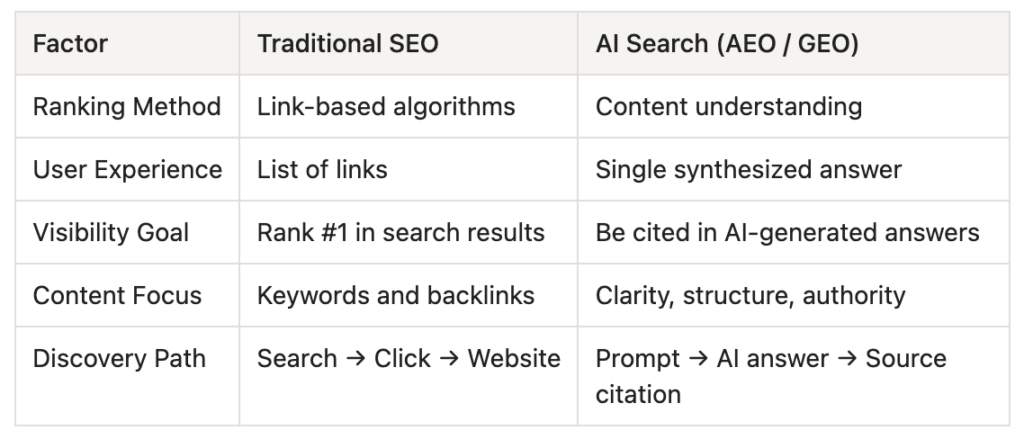
This shift means businesses must optimize for AI citation potential, not just search rankings.
The AI Answer Funnel Explained
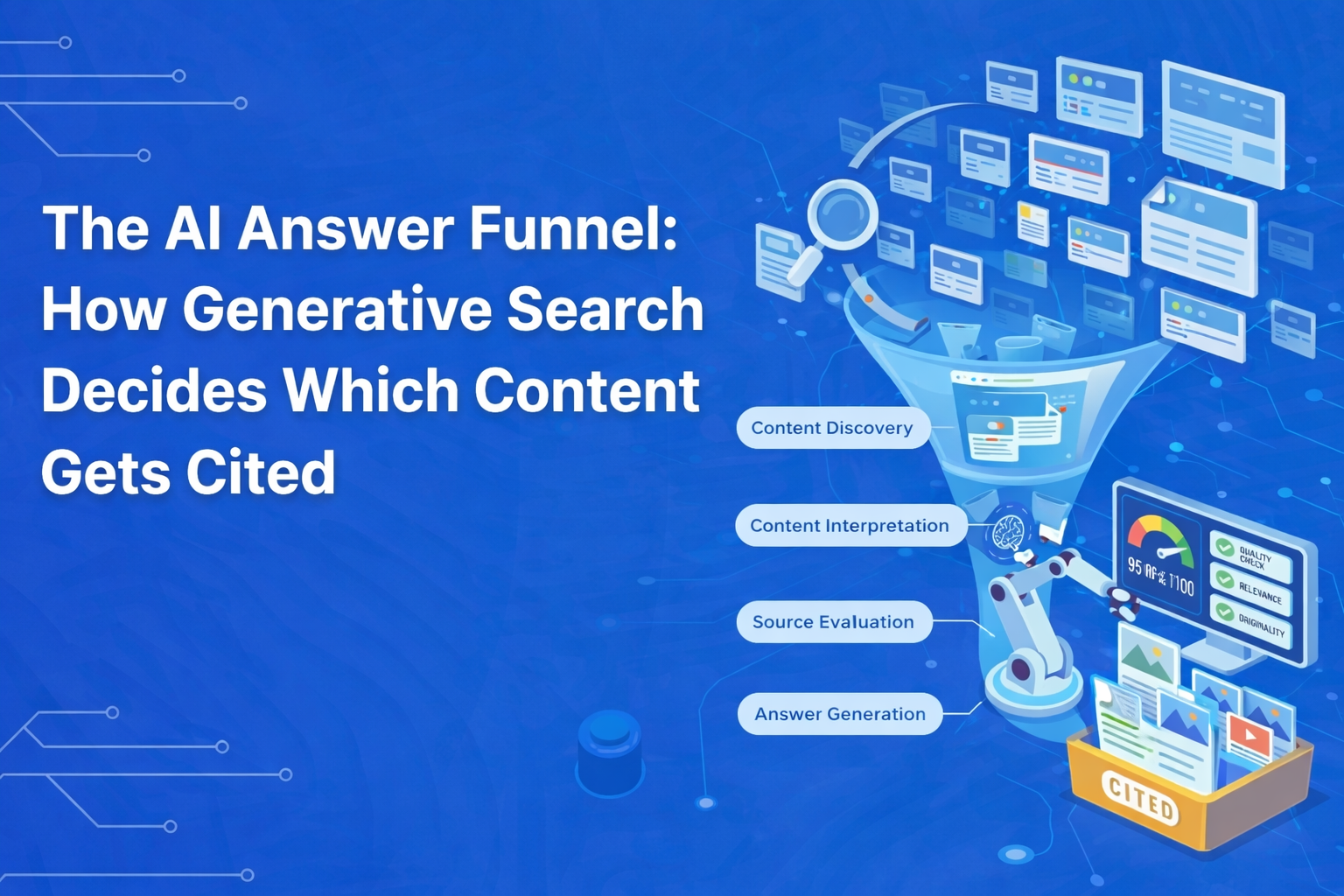
The AI Answer Funnel consists of four major stages that determine whether a piece of content will be included in an AI-generated response.
| Funnel Stage | Description | Key Optimization Factor |
|---|---|---|
| Content Discovery | AI systems locate relevant web pages | Crawlability |
| Content Interpretation | The model understands the content | Semantic clarity |
| Source Evaluation | Credibility and authority are assessed | Entity reputation |
| Answer Generation | AI synthesizes the final response | Extractable insights |
Each stage removes a large number of potential sources.
For example, thousands of pages may discuss a topic, but only a handful will pass through every stage of the funnel and appear in the final AI answer.
Stage 1: Content Discovery
The first stage of the AI Answer Funnel involves identifying relevant content.
AI systems rely on search indexes, knowledge bases, and retrieval mechanisms to locate potential sources. If your content cannot be easily discovered, it will not enter the funnel.
Common discovery barriers include:
- blocked pages in robots.txt
- poor internal linking
- weak topic relevance
- inaccessible content formats
Ensuring that content is technically accessible and clearly indexed is the foundation of AI visibility.
Stage 2: Content Interpretation
Once AI systems locate content, they must interpret it.
Large language models analyze structure, context, and meaning to determine whether a page contains useful information.
Content that is poorly structured or overly complex may fail at this stage.
The following elements improve interpretability:
| Content Element | Why It Helps AI |
|---|---|
| Clear headings | Organizes information |
| Bullet points | Enables fast extraction |
| Short paragraphs | Improves readability |
| Definitions | Provides clear explanations |
| FAQ sections | Aligns with conversational queries |
Content written in this format becomes easier for AI models to analyze and summarize.
Stage 3: Source Evaluation
Not every source is treated equally by AI systems.
During this stage, AI assistants assess the credibility and authority of a source.
Several signals influence this evaluation.
| Authority Signal | Example |
|---|---|
| Brand recognition | Well-known companies |
| External citations | Mentions on other sites |
| Topical authority | Multiple articles on a subject |
| Consistency | Reliable publishing history |
| Entity signals | Clear brand identity |
If a website demonstrates strong authority signals, it becomes more likely to pass through this stage of the funnel.
Stage 4: Answer Generation
The final stage involves synthesizing the AI response.
The model combines insights from the selected sources and produces a structured answer.
However, only a small number of sources are cited.
Research across AI search platforms shows that most AI responses include between three and six citations.
| Stage | Approximate Content Volume |
|---|---|
| Relevant pages discovered | Thousands |
| Interpreted successfully | Hundreds |
| Evaluated as authoritative | Dozens |
| Cited in AI answers | 3–6 sources |
This extreme filtering explains why many websites struggle to appear in AI-generated answers.
Why the AI Answer Funnel Matters for Businesses
The emergence of the AI Answer Funnel fundamentally changes how digital visibility works.
In traditional search, a lower-ranking website still had an opportunity to attract traffic if users scrolled through results.
In AI search, that opportunity disappears.
If your content does not reach the final stage of the funnel, users may never encounter your brand.
This creates several challenges for organizations.
Reduced Discoverability
AI assistants may repeatedly cite the same sources, leaving many competitors invisible.
Concentrated Authority
Well-known brands can dominate citations due to existing authority signals.
Invisible Competition
Companies may lose potential customers without realizing that AI systems are excluding their content.
How LLM Audits Reveal Funnel Weaknesses
One way to diagnose visibility issues is through an LLM audit.
An LLM audit evaluates how AI systems interact with your content across the entire answer funnel.
| Audit Area | What It Evaluates |
|---|---|
| Crawlability | Whether AI systems can access pages |
| Content structure | AI readability |
| Entity strength | Brand authority signals |
| Citation presence | Whether AI systems mention the brand |
| Competitor analysis | Which brands dominate AI answers |
These insights allow businesses to identify where they are dropping out of the funnel.
Optimizing Content for the AI Answer Funnel
Organizations can improve their chances of passing through the funnel by focusing on several key optimization strategies.
1. Structure Content for Extraction
AI systems prefer content that is easy to summarize.
Use:
- headings
- bullet lists
- clear explanations
- structured sections
2. Build Entity Authority
AI assistants rely on entity recognition to identify credible sources.
Strengthen brand signals through:
- digital PR
- research publications
- industry mentions
- expert contributions
3. Publish Topic Clusters
Rather than publishing isolated articles, create clusters of related content around a central theme.
This demonstrates expertise and improves topical authority.
4. Create AI-Friendly Summaries
Include sections such as:
- definitions
- key takeaways
- step-by-step explanations
These sections are easily extracted by AI systems.
The Future of Search: Answer Engines
The rise of generative search signals a shift from search engines to answer engines.
Instead of navigating multiple websites, users increasingly rely on AI assistants to summarize information and guide decisions.
This trend will likely accelerate as AI systems become more integrated into everyday digital experiences.
Businesses that understand the AI Answer Funnel will gain a major advantage in this environment.
By optimizing content for discovery, interpretation, authority, and extractability, organizations can improve their chances of being cited by AI assistants.
Key Takeaways
- Generative AI search relies on an AI Answer Funnel that filters sources before generating responses.
- Only a small number of websites are cited in AI-generated answers.
- Content must pass through stages of discovery, interpretation, evaluation, and synthesis.
- Structured, authoritative content has the highest chance of being included in AI answers.
- LLM audits help identify where websites fail within the AI Answer Funnel.