In today’s rapidly evolving digital landscape, a new competitive frontier has emerged: Artificial Intelligence Optimization (AIO). Brands are no longer competing only for top positions on search engine results pages. They are now competing to become the cited source in AI-generated answers from tools like ChatGPT, Claude, Microsoft Copilot, and Google’s AI Overviews.
This shift raises a crucial question for SEO professionals and brand leaders:
Does traditional web authority — particularly mentions on high-traffic, reputable websites — translate into visibility within AI-generated content?
The data strongly suggests that it does.
At LLMAudit.ai, we analyze how generative AI systems reference, associate, and recall brands across multiple large language models. Our research consistently reveals a strong relationship between traditional authority signals and AI visibility. High-traffic mentions not only strengthen search rankings but also increase the likelihood of being referenced or recalled by AI systems.
This article explores why high-traffic mentions matter in the AI era and how brands can leverage this reality.
Why High-Traffic Mentions Influence AI Visibility
Understanding this relationship requires examining how large language models access and prioritize information. Two key mechanisms shape AI outputs: pre-training data curation and retrieval-augmented generation (RAG).
Through continuous monitoring and AI prompt analysis, LLMAudit.ai has observed that brands consistently mentioned on authoritative domains appear more frequently in model outputs and summaries.
1. Pre-Training Data: The Quality Filter Effect
Large language models are trained on massive datasets sourced from publicly available internet content. However, engineers prioritize data quality to improve reliability and reduce noise.
High-traffic, high-credibility websites — including major news outlets, academic sources, and recognized industry publications — often act as proxies for quality.
When a brand appears repeatedly on trusted platforms such as Forbes, The New York Times, or leading industry journals, those mentions become part of high-confidence training data. Over time, the model learns that the brand is relevant, credible, and important within its category.
Our analysis at LLMAudit.ai shows that repeated presence on authoritative domains significantly increases the probability of brand recall during category-level AI queries.
2. Retrieval-Augmented Generation (RAG): Real-Time Authority Signals
Modern AI systems increasingly rely on retrieval-augmented generation. Instead of relying solely on training data, they retrieve real-time information from the web to answer queries.
When performing real-time retrieval, AI systems depend heavily on search ranking signals to determine which sources to read and summarize. High-traffic authoritative websites already rank well due to strong domain authority, backlinks, and trust signals.
As a result, these sources are far more likely to be selected and cited in AI-generated answers.
LLMAudit.ai testing confirms that brands mentioned within top-ranking authoritative sources are significantly more likely to appear in real-time AI summaries.
Visualizing the Relationship Between Authority and AI Citations
Based on aggregated prompt testing and visibility tracking, the relationship between source authority and AI citation likelihood can be visualized as follows:
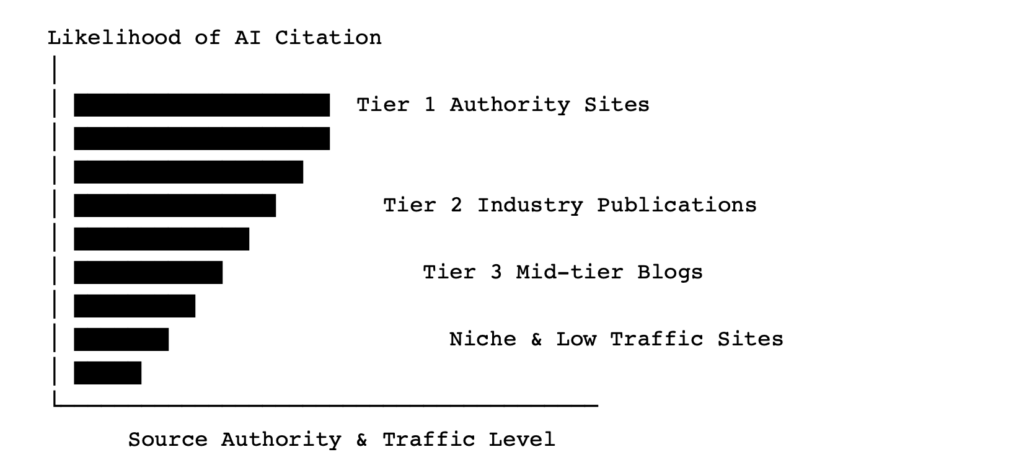
Data gathered by LLMAudit.ai indicates that Tier-1 domains provide disproportionately higher AI visibility compared to low-traffic sources.
The Echo Effect: How Authority Amplifies AI Recall
To illustrate the impact, consider two comparable software brands pursuing different off-page strategies.
Authority Impact Comparison
| Metric | Brand A (High-Traffic Strategy) | Brand B (Low-Traffic Strategy) |
|---|---|---|
| Primary Mention Sources | TechCrunch, G2, NYT, HubSpot | Small niche blogs |
| Avg. Monthly Traffic | > 5 million | < 50,000 |
| Training Data Priority | High | Low |
| AI Unaided Recall Rate* | ~65% | ~15% |
| RAG Citation Likeliness | Very High | Low |
Unaided recall reflects how often AI mentions a brand when answering category questions without prompting.
LLMAudit.ai testing consistently shows that high-authority mentions create a reinforcing “echo effect,” amplifying brand recognition across AI outputs.
Why Authority Signals Matter More in the AI Era
Traditional authority metrics now serve a dual role. They influence both search rankings and AI knowledge formation.
High-traffic mentions contribute to:
- increased presence in curated training datasets
- improved likelihood of real-time retrieval citations
- stronger perceived brand credibility
- enhanced AI recall and entity recognition
In the generative search ecosystem, authority does not just improve visibility — it shapes knowledge.
Actionable Strategies for AI Optimization (AIO)
If digital PR and off-page SEO once seemed optional, the rise of AI search has made them essential.
Prioritize Definitive Sources
Seek mentions in platforms considered authoritative in your industry. Knowledge hubs, research publications, and trusted reports are heavily weighted in AI training.
Target High-Traffic Media
Securing placements in Tier-1 media outlets strengthens both traditional SEO authority and AI visibility.
Build Category Authority
Publish original research and insights to position your brand as a primary knowledge source.
Monitor Your AI Visibility
You cannot optimize what you cannot measure. Tools like LLMAudit.ai help brands understand how AI models perceive their entity presence, sentiment, and visibility across model responses.
Measuring AI Brand Presence with LLMAudit.ai
Understanding your AI footprint requires new metrics beyond traditional SEO.
LLMAudit.ai enables brands to:
- evaluate brand mentions across major LLMs
- analyze sentiment and contextual associations
- measure category-level recall
- monitor changes in AI visibility over time
This insight helps organizations ensure their high-authority placements translate into real AI influence.
The Future of Authority: From Links to Knowledge Signals
Search is evolving from ranking pages to generating knowledge-based answers. Authority signals now function as knowledge signals that shape how AI models learn, retrieve, and present information.
Brands that build credibility through trusted, high-traffic sources are effectively teaching AI systems that their expertise is notable and reliable.
Final Insights
Does being mentioned on high-traffic pages influence AI mentions? The evidence strongly supports this conclusion.
Generative AI systems rely on authoritative domains as signals of credibility and relevance. When your brand appears on high-traffic, trusted platforms, it becomes more likely to be learned, retrieved, and cited by AI systems.
Through ongoing analysis and monitoring, LLMAudit.ai continues to demonstrate that authoritative mentions are a critical driver of AI visibility.
In the era of generative search, traditional authority metrics are no longer just ranking factors. They are the foundation of AI recognition and influence.
Brands that invest in authoritative placements today are not only improving SEO performance — they are shaping how the next generation of search understands and references their expertise.