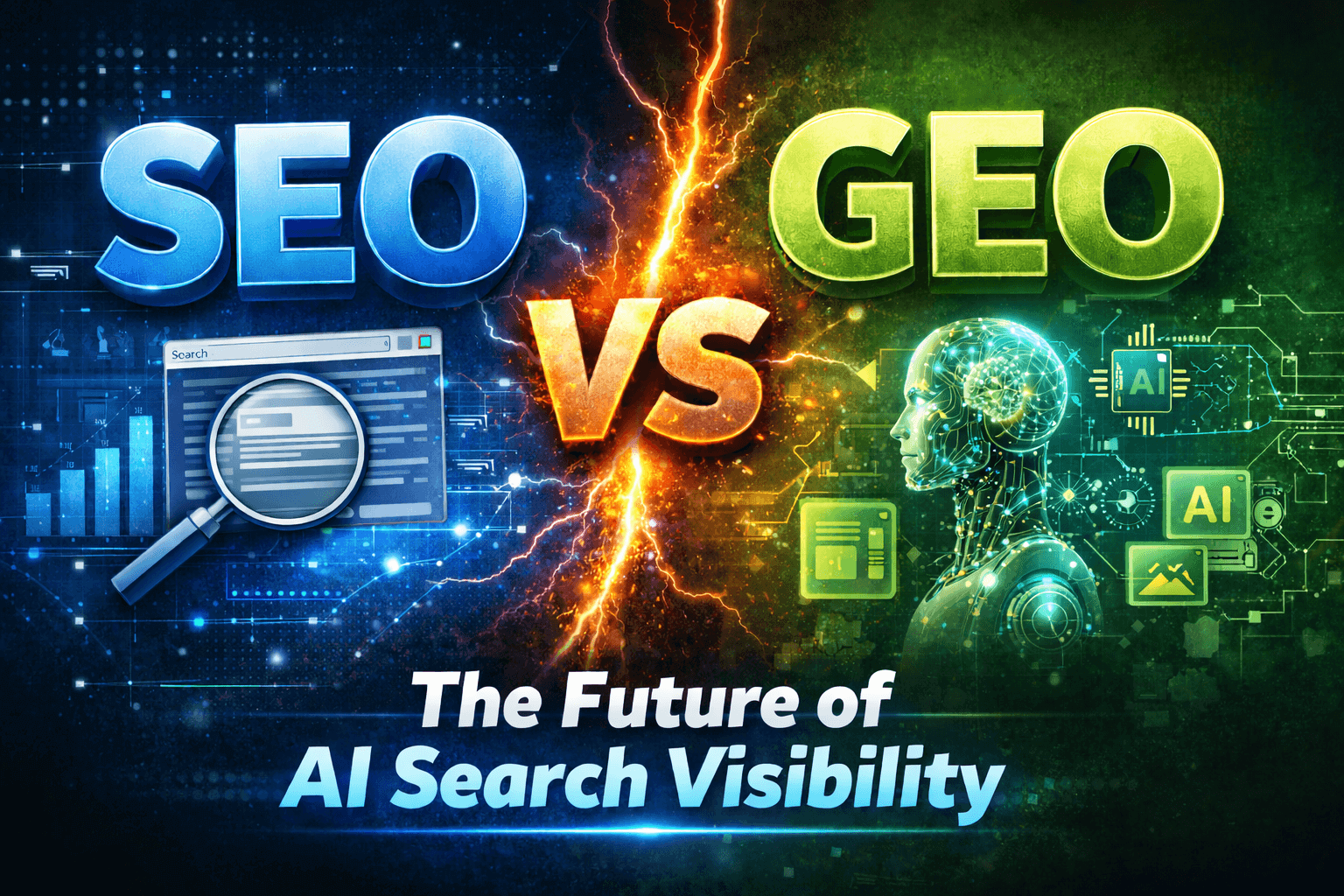
Discover the key differences between SEO vs GEO and learn how to optimise your content for both traditional search engines and AI-powered tools.
The digital marketing landscape is shifting faster than ever. For years, Search Engine Optimisation (SEO) was the undisputed king of online visibility. But a new challenger has entered the arena — Generative Engine Optimisation (GEO). Understanding the difference between SEO vs GEO is no longer optional; it is becoming essential for anyone who wants their content to be discovered in 2025 and beyond.
What Is SEO? A Quick Refresher
SEO is the practice of optimising your website and content so that traditional search engines like Google, Bing, and Yahoo rank it higher in their results pages (SERPs). It involves a combination of technical improvements, keyword targeting, link building, and high-quality content creation. The goal is simple: get more organic traffic by appearing in front of people when they search for relevant terms.
SEO has been the backbone of digital marketing for over two decades. It is data-driven, measurable, and deeply tied to how search algorithms evaluate authority and relevance. If you have ever worked on on-page optimisation, backlink profiles, or Core Web Vitals, you are already well-versed in the world of SEO.
What Is GEO? The New Frontier
Generative Engine Optimisation — or GEO — is the practice of optimising content so it is cited, referenced, or surfaced by AI-powered tools such as ChatGPT, Google’s AI Overviews, Perplexity, Microsoft Copilot, and other large language model (LLM)-based search experiences. When a user asks an AI a question, that AI pulls from indexed and crawled web content to construct an answer. GEO is about making sure your content is the one being used.
Unlike traditional SEO — where rankings are visible and click-through rates are trackable — GEO operates in a more nuanced space. The AI may summarise your content without ever sending a visitor to your website. This raises important questions about how we measure value and visibility in the age of generative search.
SEO vs GEO: The Core Differences
At first glance, SEO and GEO might seem like the same thing wearing different hats. Both care about content quality, relevance, and authority. But the mechanics differ significantly:
- Audience: SEO targets search engine algorithms; GEO targets AI language models and their reasoning processes.
- Success Metrics: SEO is measured by rankings, impressions, and clicks; GEO is measured by AI citation frequency and brand mentions in generated responses.
- Content Style: SEO rewards keyword-rich, structured content with strong backlinks; GEO rewards authoritative, well-sourced, conversational, and factually precise content.
- Intent Matching: Both care deeply about user intent, but GEO places even greater emphasis on direct, clear, and comprehensive answers to questions.
- Speed of Change: SEO evolves with algorithm updates (Google’s core updates, for instance); GEO evolves as AI models are retrained and their retrieval mechanisms improve.
Where SEO and GEO Overlap
Despite their differences, SEO and GEO share a strong common foundation. High-quality, trustworthy content is the cornerstone of both strategies. Google’s E-E-A-T framework (Experience, Expertise, Authoritativeness, and Trustworthiness) — long central to SEO — is equally valued by AI systems that prefer credible, well-structured sources.
Technical hygiene matters for both too. Fast-loading pages, clean site architecture, structured data (schema markup), and mobile responsiveness all signal credibility — whether the reader is a human arriving from a SERP or a crawler preparing data for an AI model.
In this sense, a good SEO foundation is also a strong GEO foundation. The two are not in competition; they are complementary strategies for a world where search happens across multiple channels and interfaces.
How to Optimise Both SEO and GEO
The good news is that you do not have to choose one over the other. Here is how to build a content strategy that honours both:
Write for humans first:
Both search engines and AI models are increasingly good at detecting whether content genuinely helps readers. Depth, clarity, and accuracy matter more than keyword density.
Use clear headings and structured formats:
AI models find it easier to cite content that is logically structured with H2S, bullet points, and short paragraphs.
Build genuine topical authority:
Cover subjects comprehensively across multiple pieces of content.
Add citations and data:
AI systems prefer content backed by stats, research, and reputable sources. Reference studies, link to credible external sources, and keep your facts current.
Optimise for conversational queries:
GEO thrives when your content directly answers the kinds of questions people ask in natural language—the same approach that powers featured snippets in traditional SEO.
Keep content fresh:
Both Google’s crawlers and AI training pipelines favor up-to-date information. Regularly update key articles to reflect the latest developments in your field.
The smartest digital marketers are not picking sides in the SEO vs GEO debate—they are building strategies that win in both arenas.
Whether you are a content creator, a business owner, or a seasoned marketing professional, now is the time to understand and adapt to this dual landscape. The brands that invest in both disciplines will be the ones that remain visible, credible, and competitive as search continues to evolve.
FAQs
SEO (Search Engine Optimisation) focuses on ranking content in traditional search engines like Google. GEO (Generative Engine Optimisation) focuses on getting your content cited or referenced by AI-powered tools like ChatGPT, Perplexity, and Google’s AI Overviews. Both aim to increase visibility, but they target different types of search experiences.
You can manually test this by entering relevant questions into tools like ChatGPT, Perplexity, or Google’s AI Overviews and checking whether your brand, website, or content is referenced. Emerging third-party tools are also beginning to track AI visibility like llmaudit.ai.
Content that performs best for GEO is authoritative, factually precise, and written in a clear question-and-answer or explanatory format.
GEO results can be harder to measure than traditional SEO timelines. Consistent, high-quality, authoritative content published over time is the most reliable long-term GEO strategy.
GEO can influence traffic in complex ways. If an AI tool summarises your content in its response, users may get what they need without clicking through—potentially reducing direct traffic.