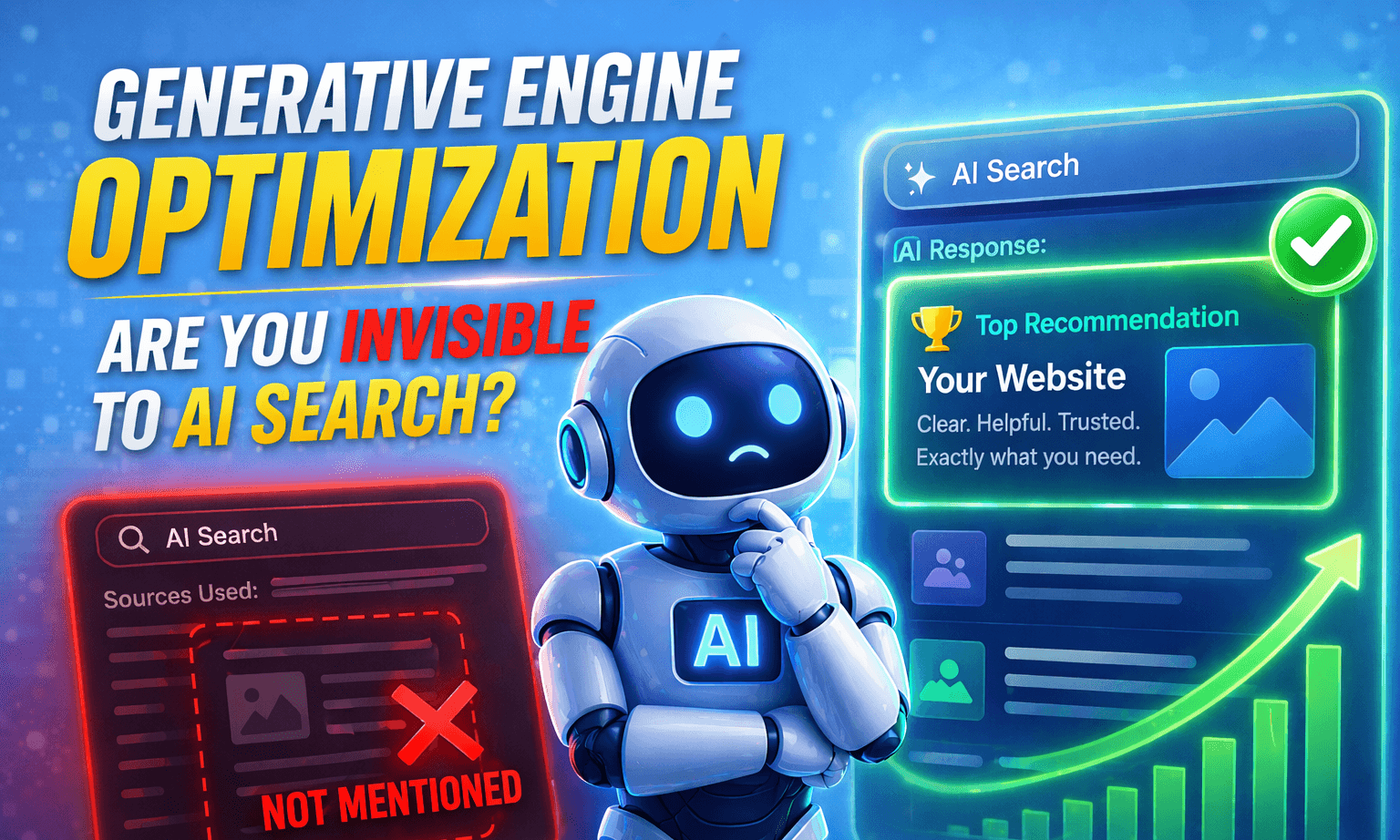
Search has split into two games.
The first is the one you already know: rank on Google, earn clicks, and drive traffic. The second is newer, faster-growing, and most SEO teams are still losing it by default. That second game is Generative Engine Optimization (GEO) the practice of getting your content cited inside AI-generated answers.
If traditional SEO earns you a spot among 10 blue links, Generative Engine Optimization earns you a place among the 2–7 sources an AI cites in a single response.
This guide covers what GEO is, how it differs from SEO, and what actually works in 2026.
What Is Generative Engine Optimization?
Generative Engine Optimization is the practice of structuring and writing content so that AI systems — ChatGPT, Perplexity, Google AI Overviews, Gemini, Copilot — cite it when they answer user queries.
In simple terms, traditional SEO gets you ranked while Generative Engine Optimization gets you cited.
Why GEO Matters: The Numbers
The data makes the urgency clear:
- 60% of searches now end without a click, and the CTR at position 1 with an AI Overview is just 2.6%.
- Fewer than 12% of marketing teams have a documented strategy for appearing in AI-generated answers.
- Brands that appear in AI-generated answers see a 38% click lift and a 39% increase in paid ad clicks.
In other words, ranking is no longer enough. Meanwhile, most competitors have not yet adapted. That gap is the opportunity. You can utilise this opportunity and be in your top A game.
GEO vs. Traditional SEO
GEO does not replace SEO. Instead, it runs on top of it.
99% of AI Overviews cite content from the organic top 10, so strong traditional SEO remains the foundation. However, being in the top 10 no longer guarantees you get cited. That is exactly where Generative Engine Optimization takes over.
| Factor | Traditional SEO | Generative Engine Optimization |
| Goal | Rank in SERPs | Get cited in AI answers |
| Success metric | Rankings & clicks | Citation frequency |
| Content focus | Keyword density | Factual density & structure |
| Authority signal | Backlinks | Data richness, citations |
What Actually Works?
The original GEO paper from Princeton (KDD 2024) tested nine optimization methods across 10,000 queries. The top-performing methods — Statistics Addition, Cite Sources, and Quotation Addition — boosted content visibility in AI responses by 30–40%. Keyword stuffing, by contrast, performed poorly.
Here is what to act on:
1. Answer first, explain later Your first 200 words must directly answer the query. Because AI systems evaluate opening content heavily, long build-ups get skipped.
2. Add specific data Vague claims get ignored, but specific numbers get cited. Aim for 2–3 data points per 300 words.
3. Use question-based headers “What is Generative Engine Optimization?” consistently outperforms “GEO Overview.” Mirror the actual queries your audience types.
4. Structure content for extraction FAQs, numbered lists, and comparison tables rank among the top predictive features for AI citation. Therefore, every key page needs at least one structured section.
5. Refresh content regularly New content enters AI citation pools within 3–5 business days, but older articles lose citation priority without freshness updates. As a result, build a refresh cadence into your workflow.
How to Measure Generative Engine Optimization Performance
This is where most teams fall short. Traditional dashboards simply do not capture GEO performance. The metrics that matter are:
- Citation frequency — how often your brand appears in AI answers
- Share of Model (SoM) — your citation rate vs. competitors
- AI-referred traffic — sessions arriving from ChatGPT, Perplexity, and similar tools
Most SEO tools are not built for this, while LLM Audit is. It tracks how your content performs inside AI-generated responses, surfaces which pages get cited, and shows where competitors are being selected over you. It also shows how you do in certain prompts and gives recommendations on what to change. For teams investing in Generative Engine Optimization, that level of visibility is essential.
Start Now. The Advantage Compounds.
Citation authority builds over time, just as domain authority once did. The brands investing in Generative Engine Optimization in 2026 will be the ones AI systems cite in 2027 and beyond.
Furthermore, with 50% of searches projected to be generative by 2028, a purely traditional SEO strategy is becoming insufficient.
The teams that move now will build a head start that is very hard to close later.
Would you want to be in the ones that get cited or the ones that are lost in the crowd?
FAQs
No. Strong traditional SEO is still the foundation — most AI systems pull from high-ranking pages. However, Generative Engine Optimization is the additional layer that determines whether ranked content actually gets cited.
Statistics-rich content, FAQ sections, numbered lists, comparison tables, and direct-answer openings perform best. Keyword stuffing, on the other hand, actively reduces citation rates.
Track citation frequency, Share of Model, and AI-referred traffic. Tools like LLM Audit are built specifically to monitor these metrics across AI platforms.
Updated content can enter AI citation pools within 3–5 business days. However, meaningful citation improvements typically take 30–60 days of consistent optimization.