Try this before you read further
Open ChatGPT and search for the core problem your product solves. For example:
- “best tools for team collaboration”
- “easy design software for beginners”
- “top marketing platforms for small businesses”
Is your brand in the response? Or do you see the same familiar names again and again?
What AI Tools Recommend and What They Ignore
AI tools don’t return a list of links. Instead, they generate a single, curated response and mention only a few brands they trust.
Here’s what that looks like in practice:
| Query | Consistently recommended | Often invisible |
| “Best marketing automation tools” | HubSpot, Mailchimp, ActiveCampaign | Most mid-market & niche tools |
| “Productivity tools for teams” | Notion, Asana, Monday.com | Equally capable alternatives |
| “Design tools for beginners” | Canva, Adobe Express | Newer or less-cited competitors |
| “AI writing assistants” | Jasper, Copy.ai, Grammarly | Many well-reviewed alternatives |
This pattern isn’t random. Instead, it reflects how AI systems evaluate and rank brands based on signals across the web.
Why This Matters More Than Traditional SEO
For years, SEO meant ranking on page one. Users compared multiple options and then clicked.
However, that behavior is changing fast.
AI-driven search tools will handle over 25% of informational queries by 2026. More importantly, users rarely explore beyond the first few recommendations. In most cases, they act on the top two or three brands.
As a result, if your brand doesn’t appear in the response, it doesn’t enter the consideration set at all.
This shift introduces a new challenge: Generative Engine Optimisation (GEO).
Now, you must optimize not just for search engines, but for AI models that shape discovery.
The four signals AI models use to decide who gets recommended
AI systems don’t read your website in isolation. They synthesise signals from across the internet. Brands that consistently appear in AI responses tend to score highly on all four of the following:
| Citation breadth | Consistent positioning | Recency of mentions | Authoritative context |
| Mentioned frequently across credible blogs, review sites, forums, and publications, not just your own domain. | Described in similar terms across many sources. Inconsistent messaging confuses AI models about what you do. | Brands with fresh, ongoing coverage are weighted more heavily than those with a single spike of old mentions. | Referenced in expert guides, industry comparisons, and educational content with clear, structured framing. |
Why Strong SEO Doesn’t Guarantee AI Visibility
This is where most businesses get it wrong.
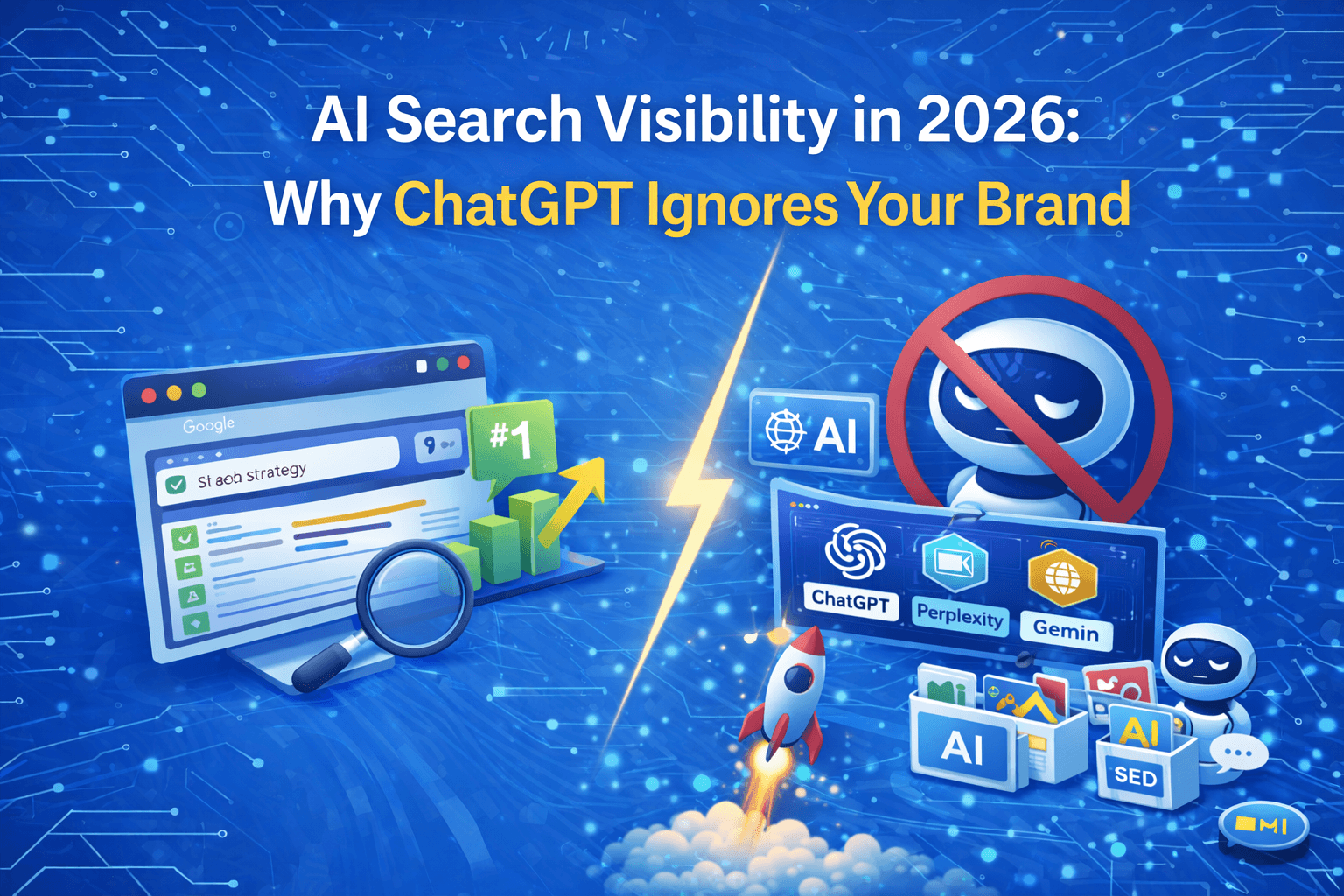
You can rank #1 on Google and still remain invisible in AI results.
Here’s why:
Search engines prioritize your website — optimized pages, backlinks, and technical SEO.
In contrast, AI models prioritize third-party validation.
As a result, a brand with average SEO but strong external mentions often outperforms a top-ranking website with weak brand presence.
In fact, many companies now report strong organic traffic but almost zero visibility in AI tools. The issue isn’t product quality — it’s lack of external brand signals.
Real-World Patterns: Why Some Brands Always Show Up
Let’s break this down.
HubSpot: Authority Through Education
HubSpot earns visibility because thousands of bloggers, educators, and marketers reference its resources. These mentions add context, not just links — and AI models reward that.
Notion: Community-Driven Growth
Notion benefits from massive user-generated content — templates, tutorials, and discussions. This creates a dense network of independent mentions across the web.
Canva: Consistent Positioning
Across millions of articles, “easy design tool” and Canva appear together repeatedly. Over time, AI models associate the two almost automatically.
The Limits of Traditional Brand Monitoring
Most companies track brand mentions using social listening tools or Google Alerts.
However, those tools answer only one question:
“Are people talking about us?”
AI visibility requires deeper insight:
- How does AI describe our brand?
- Which queries show competitors but not us?
- What external signals shape our AI presence?
- Where does our messaging mismatch AI perception?
Traditional tools don’t answer these questions.
That’s exactly where AI visibility auditing becomes critical.
Self-Check: Is Your Brand Invisible in AI Search?
Go through this checklist honestly:
☐ My brand appears when I search my core use case in ChatGPT or similar tools
☐ I understand how AI tools describe my brand
☐ I track which competitors appear more frequently than me
☐ I monitor AI visibility alongside SEO
☐ My brand appears consistently in authoritative third-party content
If you checked fewer than two, you likely have a serious AI visibility gap.
More importantly, your competitors may already be ahead.
FAQs
AI search visibility refers to how frequently and favourably your brand appears in responses generated by AI tools like ChatGPT, Gemini, Perplexity, and similar systems. Unlike SEO, which focuses on your website’s ranking in search engine results pages, AI visibility depends on how your brand is represented across third-party content that AI models have learned from. Strong SEO does not guarantee strong AI visibility.
Google ranks your content based on your site’s technical performance and backlink profile. AI language models are trained on a wider corpus and weigh how frequently and consistently your brand is mentioned in credible third-party sources. A brand with strong on-site SEO but limited external citations may rank well on Google while remaining invisible in AI-generated answers.
GEO is the practice of optimising your brand’s presence so that it is more likely to be cited and recommended by AI-powered search and discovery tools. It involves strategies such as increasing authoritative third-party mentions, standardising brand positioning language, and building content that other creators reference, all of which send stronger signals to AI systems.
You can manually test this by querying ChatGPT, Perplexity, or Gemini with the core problems your product solves and observing whether your brand is mentioned. For a systematic analysis, including competitive benchmarking and gap identification tools like LLMAudit provide structured audits of your AI search presence.