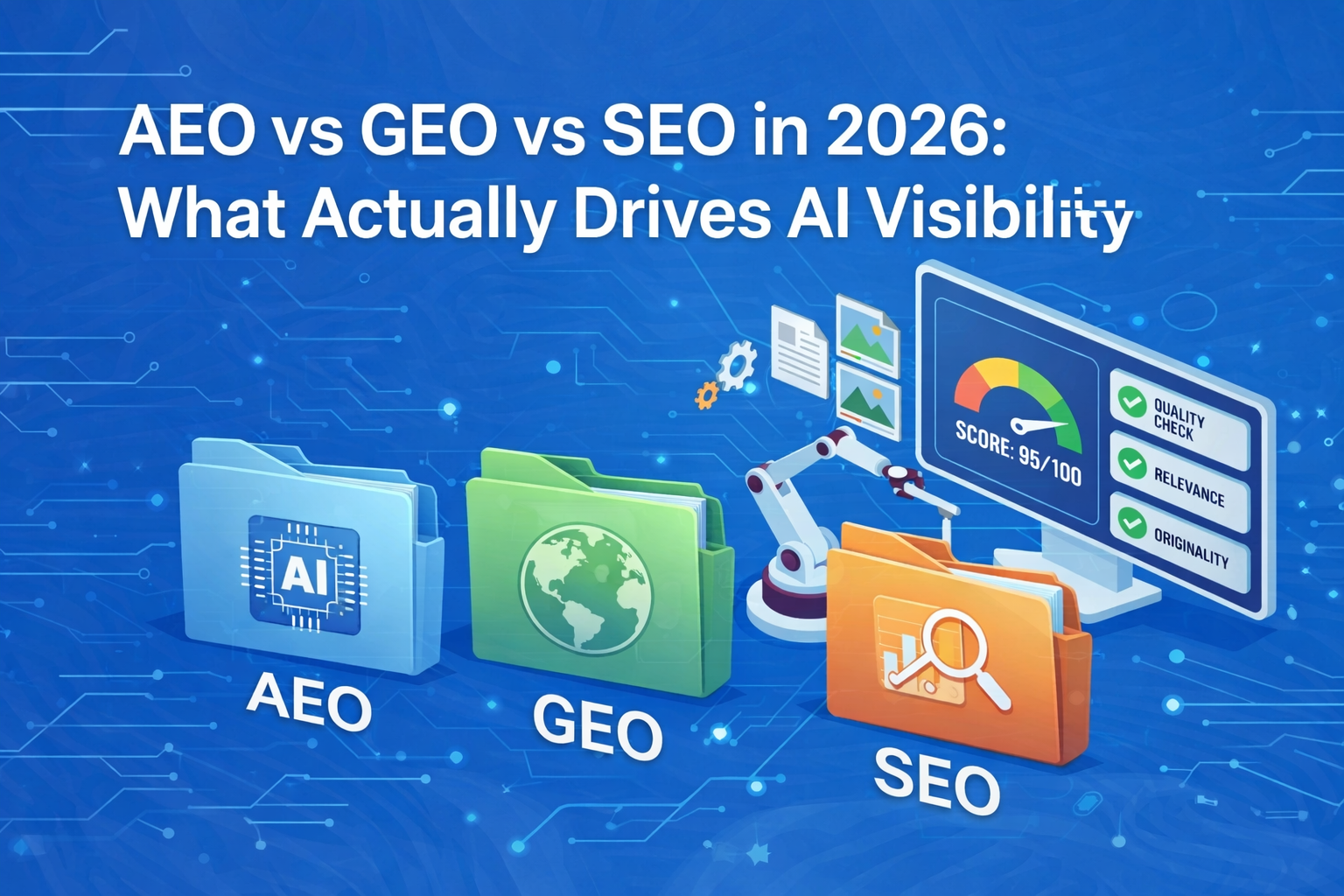
Digital visibility in 2026 is no longer limited to ranking on search engines. Brands now need to optimize for three distinct but interconnected systems: search engines, answer engines, and generative AI platforms.
This has led to the rise of three key disciplines: Search Engine Optimization (SEO), Answer Engine Optimization (AEO), and Generative Engine Optimization (GEO).
While these terms are often presented as competing approaches, they are better understood as layers of a unified strategy. Each builds upon the other to expand a brand’s visibility across different discovery channels.
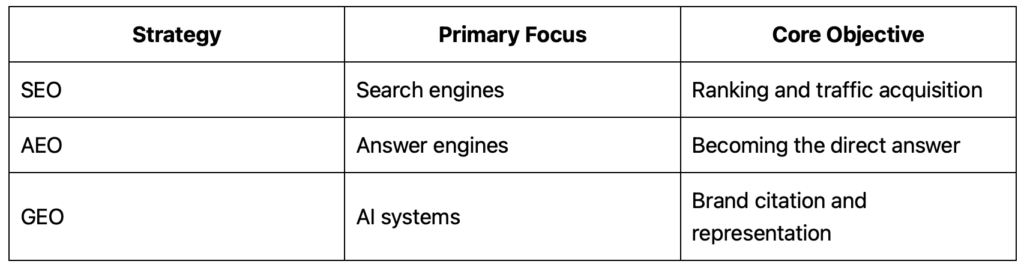
Key Differences Between SEO, AEO, and GEO
SEO: The Foundational Layer
Search Engine Optimization remains the core of digital visibility. It focuses on improving how content ranks in traditional search engines such as Google and Bing.
Core Components of SEO
Technical performance (site speed, crawlability, Core Web Vitals)
On-page optimization (keywords, headings, internal linking)
Authority signals (backlinks, brand mentions)
Content quality aligned with E-E-A-T principles
SEO is not being replaced. Instead, it provides the infrastructure that AEO and GEO depend on. Without strong SEO, AI systems cannot effectively access, evaluate, or trust your content.
Objective of SEO
Improve rankings in search results
Increase organic traffic
Drive click-through rates
AEO: Optimizing for Direct Answers
Answer Engine Optimization focuses on structuring content so that it becomes the direct answer to user queries. This includes featured snippets, voice search responses, and AI-generated summaries.
Core AEO Techniques
Use clear question-and-answer formats
Add structured data (FAQ, HowTo schema)
Write concise, direct answers at the beginning of sections
Use well-defined headings (H2, H3)
Ideal AEO Content Flow
User Query ↓ Clear Heading (H2) ↓ Direct Answer (1–2 sentences) ↓ Detailed Explanation ↓ Supporting FAQs
Objective of AEO
Capture featured snippets
Appear in zero-click results
Be selected by AI systems as the best answer
GEO: Optimizing for AI Systems
Generative Engine Optimization focuses on how a brand is represented inside AI-generated responses from platforms such as ChatGPT, Gemini, Claude, and Perplexity.
Unlike SEO and AEO, GEO is not just about content visibility but also about brand interpretation and positioning within AI systems.
Core Components of GEO
Entity Optimization
AI systems interpret brands as entities rather than keywords. A brand must clearly define:
Its category
Target audience
Unique value proposition
AI Crawler Accessibility
Ensure that AI crawlers such as GPTBot, ClaudeBot, and PerplexityBot are not blocked via robots.txt.
Third-Party Citations
External mentions on authoritative platforms significantly influence AI citation. These sources often carry more weight than a brand’s own website.
Sentiment and Representation
Monitor how AI systems describe your brand, including tone, accuracy, and comparison with competitors.
GEO Visibility Flow
Website Content ↓ AI Crawlers Access Content ↓ External Authority Signals ↓ AI Model Processing ↓ Brand Appears in AI Responses
Objective of GEO
Increase brand mentions in AI-generated answers
Improve accuracy of brand representation
Strengthen positioning against competitors
The Layered Strategy Model
SEO, AEO, and GEO function as a structured stack rather than separate strategies.
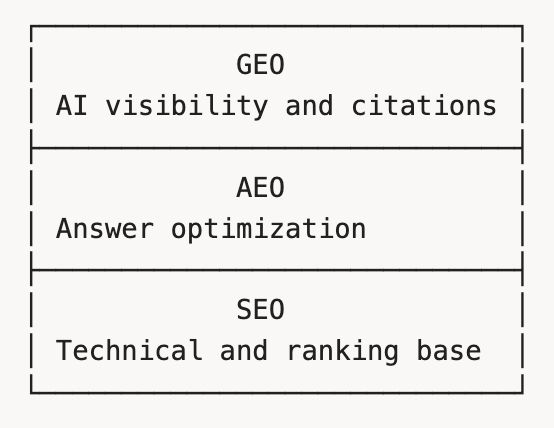
SEO builds the foundation
AEO structures content for answer extraction
GEO extends visibility into AI ecosystems
A weakness in any layer limits the effectiveness of the others.
Common Mistakes to Avoid
Treating GEO as a Replacement for SEO
GEO depends on SEO. Eliminating SEO reduces AI discoverability.
Ignoring AI Crawlers
If AI bots cannot access your content, optimization efforts are ineffective.
One-Time Optimization
AI visibility changes over time. Continuous monitoring is required.
Over-reliance on llms.txt
There is no confirmed evidence that llms.txt significantly improves AI visibility.
Superficial Content Updates
AI systems prioritize meaningful updates over cosmetic changes.
What AI Systems Prefer
Research and observed patterns indicate that AI systems favor:
Audience-specific pages over generic content
Recently updated content (within 90 days)
Strong homepage clarity
High-quality external mentions
Visible and well-structured FAQ sections
Relative Impact on AI Visibility
Audience-Specific Content High Content Freshness Medium-High Homepage Clarity Medium-High Backlinks Medium FAQ Structure Medium
The Measurement Challenge
Unlike SEO, GEO lacks mature analytics tools. AI systems do not provide traditional ranking or keyword data.
Emerging GEO Metrics
Citation Rate: Percentage of prompts where your brand appears
Share of Model: Frequency of appearance relative to competitors
Sentiment Score: Positive, neutral, or negative representation
Citation Source: Which pages are referenced
Practical Implementation Strategy
Step 1: Establish Technical Readiness
Ensure crawlability for both search engines and AI bots
Implement structured data
Optimize site performance
Step 2: Audit AI Visibility
Test multiple queries across different AI platforms and document results.
Step 3: Optimize Content for AEO
Use direct answer formats
Add structured FAQs
Improve heading clarity
Step 4: Build GEO Signals
Publish on niche authority platforms
Strengthen brand positioning
Increase external mentions
Step 5: Monitor and Iterate
Track AI visibility regularly and refine strategy based on changes.
Conclusion
SEO, AEO, and GEO are not competing frameworks. They represent a layered approach to digital visibility.
SEO enables discovery
AEO enables selection
GEO enables recommendation
Organizations that integrate all three will achieve stronger visibility across both traditional search and AI-driven platforms.
Run a free LLM visibility audit → — See your citation rate across major AI platforms in minutes.
Frequently Asked Questions
SEO focuses on ranking in search engines, AEO focuses on becoming the direct answer in search results, and GEO focuses on how your brand appears in AI-generated responses like ChatGPT and Gemini.
Yes, SEO remains the foundation of digital visibility. AI systems rely on search engine data, so strong SEO is essential for both AEO and GEO success.
AEO is the process of structuring content so it becomes the direct answer in featured snippets, voice search, and AI-generated responses.
GEO focuses on improving how your brand is cited and represented in AI tools like ChatGPT, Perplexity, and Gemini, including accuracy, sentiment, and visibility.
To get cited by AI tools, you need strong SEO, structured AEO content (like FAQs), clear entity positioning, and mentions on authoritative third-party websites.
Yes, AI crawlers like GPTBot and ClaudeBot must be allowed in your robots.txt file; otherwise, your content may not be used in AI-generated answers.
Content should be updated every 60–90 days with meaningful improvements such as new data, examples, and expanded coverage to maintain AI relevance.