For more than 20 years, digital visibility meant one thing: ranking on Google.
Companies invested in Search Engine Optimization (SEO) to improve their positions in traditional search engine results pages (SERPs). The strategy was straightforward:
- Target the right keywords
- Earn high-quality backlinks
- Publish optimized content
- Rank higher on Google
That approach still matters.
However, search behavior has fundamentally changed in 2026.
Today, millions of users rely on AI assistants and generative search engines instead of traditional search results. Platforms like:
- ChatGPT
- Perplexity AI
- Google AI Overviews
- Gemini
- Copilot
are increasingly becoming the first place people look for answers.
This shift has introduced a new optimization discipline:
Generative Engine Optimization (GEO).
While SEO helps users find your website, GEO ensures that AI systems recognize, trust, and cite your content when generating answers.
Companies that optimize for both SEO and GEO are capturing the largest share of visibility in the AI-driven search landscape.
What SEO Actually Does
SEO is the practice of optimizing websites so they rank higher in search engines like Google and Bing.
The goal is to appear in the top results when users search for specific queries.
How Traditional SEO Works
| Step | Process |
|---|---|
| 1 | User searches a query on Google |
| 2 | Search engine ranks relevant pages |
| 3 | Top results appear on the SERP |
| 4 | User clicks a link |
SEO focuses on signals such as:
- Backlinks
- Keyword relevance
- Technical performance
- Page speed
- User engagement
Even in 2026, SEO remains a major source of traffic.
Global Website Traffic Sources (2026)
| Source | Share |
|---|---|
| Search Engines | 46–48% |
| Direct Traffic | 27% |
| Social Media | 6% |
| AI Platforms | rapidly growing segment |
Despite AI growth, traditional search still drives nearly half of internet traffic.
However, AI-generated answers are changing how people interact with search results.
The Rise of AI Search in 2026
Modern search engines increasingly deliver AI-generated summaries instead of just links.
Google’s AI Overviews, for example, now appear in a majority of informational searches.
AI Search Trends
| Metric | Data |
|---|---|
| Searches showing AI summaries | 50–60% |
| Long-tail queries triggering AI answers | 57%+ |
| Zero-click searches when AI appears | 90%+ |
This means users often get their answers without clicking any website.
Your site may rank #1 — but the user never visits it.
Instead, the AI summarizes information from several sources and displays the answer directly.
This is where GEO becomes essential.
What Generative Engine Optimization (GEO) Is
Generative Engine Optimization (GEO) is the practice of optimizing content so that AI systems use it as a trusted reference when generating responses.
Unlike SEO, GEO does not focus on rankings.
It focuses on citations and references within AI answers.
GEO Explained
| SEO | GEO |
|---|---|
| Optimizes for search rankings | Optimizes for AI citations |
| Focuses on keywords | Focuses on information clarity |
| Drives traffic via clicks | Drives visibility via AI answers |
| Ranking metrics | Citation metrics |
For example, when someone asks an AI system:
“What is the difference between SEO and GEO?”
The AI may generate an answer using information from multiple sources.
Your goal with GEO is to ensure your content becomes one of those trusted sources.
The Four Core Differences Between GEO and SEO
1. What You’re Competing For
SEO and GEO compete for different forms of visibility.
| Metric | SEO | GEO |
|---|---|---|
| Goal | Rank in search results | Appear in AI responses |
| Visibility | Website listing | AI citation |
| Traffic source | Clicks | Mentions / references |
| Success metric | Organic traffic | Share of AI voice |
SEO success = higher rankings
GEO success = higher citation frequency
2. How Authority Is Established
Traditional SEO relies heavily on backlinks.
The more reputable sites linking to your content, the higher search engines rank it.
AI systems evaluate authority differently.
They look for consistent information across the web.
AI Authority Signals
- Structured data
- Clear factual statements
- Consistent brand descriptions
- Reliable sources referencing the brand
- Transparent authorship
A brand consistently referenced across trusted sources will be more likely to be cited by AI systems.
3. Technical Requirements
SEO technical optimization focuses on performance.
- PageSpeed
- Core Web Vitals
- Mobile responsiveness
- XML sitemaps
- Internal linking
GEO introduces AI-specific technical signals.
GEO Technical Signals
- AI crawler access (GPTBot, PerplexityBot)
- Structured schema markup
- Clean semantic HTML
- Clear heading hierarchy
- Bot accessibility
Studies show that over 60% of AI crawler visits fail when sites block bots or present CAPTCHAs.
A technically optimized SEO website can still be invisible to AI systems.
4. Content Optimization
SEO content often focuses on keyword density and topical depth.
GEO content focuses on clarity and answer precision.
SEO vs GEO Content Structure
| SEO Content | GEO Content |
|---|---|
| Keyword-rich articles | Question-driven content |
| Long paragraphs | Structured sections |
| Topic clusters | Direct answers |
| Engagement metrics | Information clarity |
AI systems prefer content that:
- clearly answers questions
- includes lists and tables
- uses structured headings
- provides factual data
The more structured and factual your content, the more likely AI will cite it.
Why GEO and SEO Are Converging
SEO and GEO are not competitors.
They are increasingly complementary strategies.
Research indicates:
SEO vs AI Citation Relationship
| Statistic | Value |
|---|---|
| AI citations from Google Top 10 pages | ~76% |
| AI cited pages outside Google Top 100 | ~80% |
This means AI systems frequently reference high-ranking pages, but they also surface content Google might not rank highly.
Companies optimizing only for SEO risk missing visibility in AI-generated responses.
GEO Metrics Businesses Should Track
Traditional SEO dashboards measure:
- rankings
- organic traffic
- click-through rate
But AI search requires new metrics.
Key GEO Metrics
| Metric | Meaning |
|---|---|
| Citation Frequency | How often AI references your brand |
| AI Share of Voice | Visibility compared to competitors |
| Brand Sentiment | Accuracy of AI descriptions |
| Platform Coverage | Presence across AI platforms |
| AI Crawlability | Accessibility for AI bots |
Monitoring these metrics helps brands understand their AI search presence.
How to Run a GEO Audit
The fastest way to assess AI visibility is to perform an LLM-based audit of your website.
A GEO audit evaluates whether your website is optimized for AI systems.
GEO Audit Checklist
| Category | What Gets Evaluated |
|---|---|
| AI Bot Access | GPTBot, PerplexityBot, CCBot |
| Schema Markup | Structured data completeness |
| Content Structure | AI readability |
| Brand Consistency | External references |
| Technical Accessibility | Errors and blocks |
Platforms like LLMAudit.ai scan websites and generate reports showing how AI systems interpret your content.
This provides a clear roadmap for improving AI search visibility.
Why GEO Is a Massive Opportunity
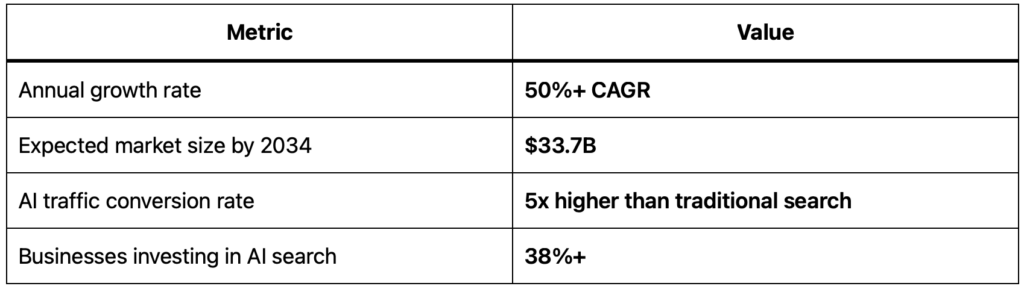
The AI search optimization market is growing rapidly.
GEO Market Growth
Companies that adopt GEO early gain a compounding advantage in AI visibility.
The Future of Search Visibility
Search is evolving from link discovery to answer discovery.
Traditional search engines list websites.
AI systems synthesize knowledge.
The businesses that succeed in 2026 focus on:
- Strong SEO foundations
- Structured, fact-based content
- AI crawler accessibility
- Consistent brand information
- Continuous GEO audits
This dual strategy ensures visibility across both search engines and AI platforms.
The Bottom Line
SEO is not disappearing.
But SEO alone is no longer sufficient in 2026.
Generative Engine Optimization is becoming a critical part of digital marketing strategy.
Brands that combine SEO and GEO gain visibility across both traditional search results and AI-generated answers.
Understanding the difference between GEO and SEO is the first step.
Auditing your website’s AI readiness is the next.
Tools like LLMAudit.ai help businesses evaluate how AI platforms interpret their content and identify opportunities to increase their chances of being cited in AI responses.
In the AI search era, visibility isn’t just about ranking.
It’s about becoming the source AI trusts.
Frequently Asked Questions About GEO vs SEO
Generative Engine Optimization (GEO) is the practice of optimizing content so AI systems like ChatGPT, Gemini, and Perplexity cite your website when generating answers.
SEO focuses on ranking webpages on search engines like Google. GEO focuses on getting your content cited inside AI-generated answers.
Yes. SEO still drives a large share of website traffic. However, GEO is becoming equally important as more users search through AI assistants.
AI search engines generate direct answers instead of only showing links. This reduces clicks and increases the importance of being cited by AI systems.
Yes. AI models often cite sources that are not in Google’s top results because they prioritize clarity, accuracy, and structured information.
A GEO audit analyzes whether your website is optimized for AI search engines by checking crawlability, content structure, schema markup, and AI citation readiness.