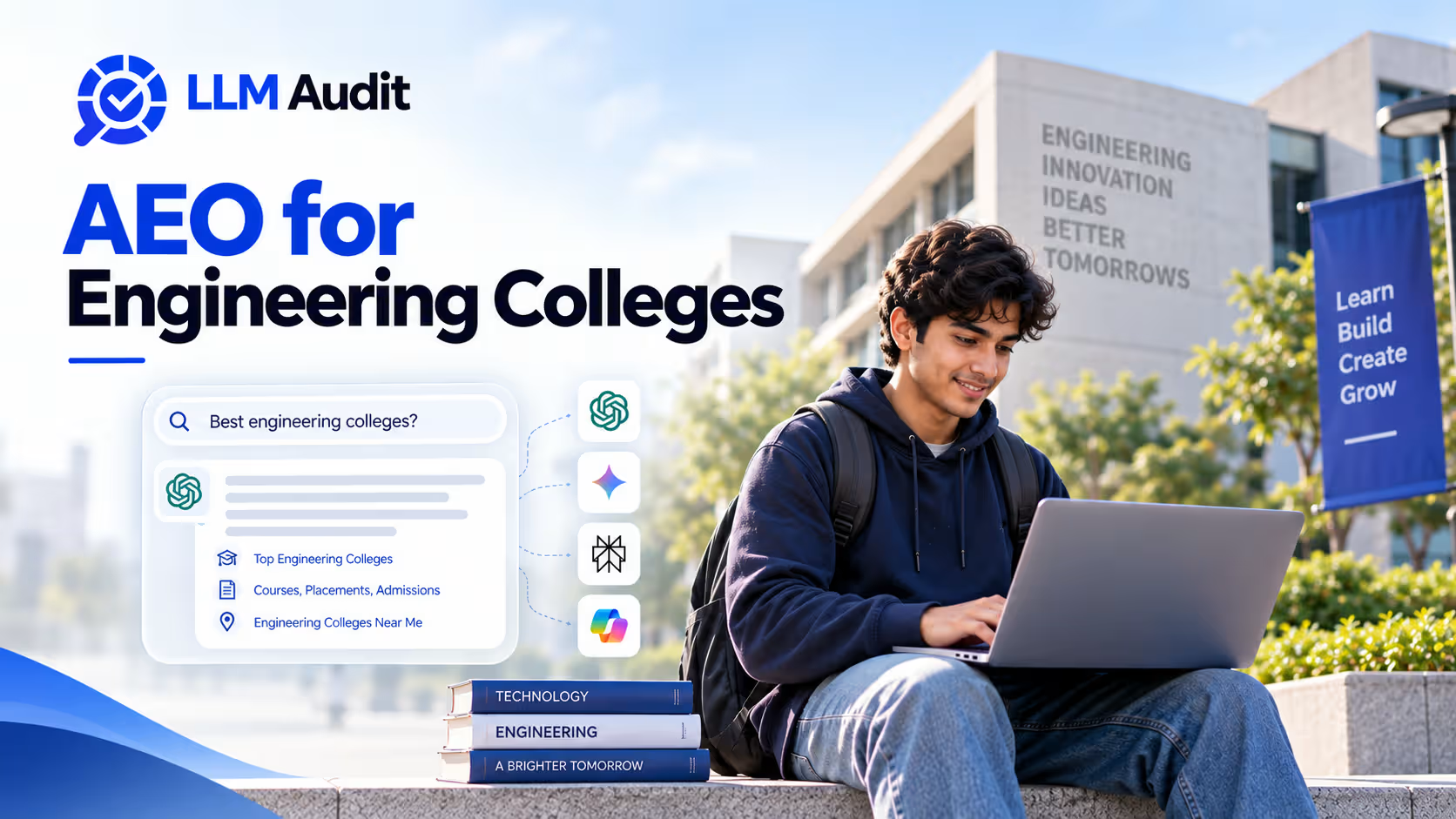
Choosing an engineering college has never been a simple search.
A prospective student may begin with a query such as “best engineering colleges in Pune,” but the research process quickly becomes much more detailed. Students ask about engineering courses, placements, fees, campus life, admission requirements, hostel facilities, faculty, specializations, internships, rankings and career opportunities.
Increasingly, those questions are being asked directly to AI platforms.
Instead of opening several websites and comparing pages manually, a student can ask ChatGPT, Gemini, Perplexity or another AI search platform to explain which engineering colleges are worth considering for a particular course, city, budget or career goal.
That creates a new visibility challenge for engineering colleges.
It is no longer enough for an institution to rank well on Google. The college also needs to be understood, recognized and accurately represented when AI systems generate answers.
This is where AEO for engineering colleges, or Answer Engine Optimization, becomes important.
AEO focuses on making institutional information easier for answer engines and generative AI systems to discover, understand, extract and cite. It works alongside traditional SEO rather than replacing it.
For colleges trying to understand what AI systems are saying about their institution, LLMAudit.ai provides a dedicated way to monitor AI visibility, citations, mentions and competitive presence across generative search environments.
What Is AEO for Engineering Colleges?
AEO for engineering colleges is the process of optimizing an institution’s website, content, structured information and online presence so that AI-powered search systems can understand and potentially cite the college when answering relevant questions.
Traditional SEO generally asks:
Where does our engineering college rank for an important search query?
AEO asks a different question:
When a student asks an AI system a question about engineering colleges, does our institution appear in the answer, and is our website used as a source?
That distinction matters.
AI-generated search experiences do not always work like conventional search results. An AI system may combine information from multiple websites and produce a synthesized response. The institution itself may be mentioned, while another website becomes the cited source. In other cases, a college may not appear at all.
Research and industry analysis in higher education are increasingly examining this shift. A 2026 exploratory study specifically examined Answer Engine Optimization in Indian higher education and the visibility of universities in AI-generated responses.
For engineering colleges, this creates a new layer of digital visibility that admissions and marketing teams need to understand.
Why AI Search Matters for Engineering College Admissions
Engineering education is a high-consideration decision.
Students rarely make the decision based on one keyword or one webpage. They compare multiple institutions and repeatedly refine their questions.
For example, a student interested in computer science might ask:
“Which are the best engineering colleges for computer science in Pune?”
The next question might be:
“Which colleges have good placement opportunities?”
Then:
“What is the average fee for computer engineering?”
Then:
“Which engineering colleges accept MHT CET?”
And eventually:
“Which college should I consider if I want to build a career in AI?”
These are not simply keyword searches. They are conversational research journeys.
AI platforms are particularly suited to this type of discovery because users can ask follow-up questions without starting the research process again.
Higher education marketers are already paying attention to this behavior. Recent industry coverage of AEO in higher education describes prospective students using AI assistants to research programs, costs and institutions, while emphasizing the importance of clear structure, factual information and authoritative sources.
For an engineering college, this means its digital strategy needs to answer the questions students actually ask, not merely optimize a handful of commercial keywords.
AEO vs SEO for Engineering Colleges
SEO and AEO should not be treated as competing strategies.
They solve related but different visibility problems.
| Traditional SEO | AEO for Engineering Colleges |
|---|---|
| Focuses on search rankings | Focuses on inclusion in AI-generated answers |
| Targets search engine results pages | Targets answer engines and generative search |
| Measures rankings and organic traffic | Measures mentions, citations and AI visibility |
| Optimizes pages for search intent | Optimizes information for extraction and answers |
| Builds search authority | Builds machine-readable and evidence-based authority |
| Primarily measures clicks | Measures whether AI systems use the institution as a source |
A college that already has strong SEO has a useful foundation for AEO. Crawlability, high-quality content, technical SEO, authoritative references and a strong institutional entity can all contribute to the broader visibility picture.
But ranking on Google does not automatically mean an institution will be cited by AI systems.
LLMAudit.ai describes this as a visibility gap: traditional SEO tools can tell you where a page ranks, but they generally cannot tell you what ChatGPT, Perplexity or other AI systems are saying about the brand.
That is why engineering colleges should begin measuring both.
What Questions Should Engineering Colleges Optimize For?
One of the biggest mistakes in AEO is thinking only in terms of short keywords.
A student does not always ask:
“engineering colleges Pune”
They may ask:
“What are the best engineering colleges in Pune for computer science?”
“Which engineering colleges in Maharashtra have strong placement records?”
“What are the eligibility requirements for BTech admission?”
“Which engineering colleges offer artificial intelligence and machine learning?”
“Which college is good for mechanical engineering after MHT CET?”
“Which engineering colleges have affordable fees?”
“Which engineering colleges have good hostel facilities?”
“Which engineering colleges have strong industry connections?”
These longer questions reveal the information architecture that an engineering college needs.
Instead of creating one generic admissions page and expecting it to answer everything, colleges should build a comprehensive information ecosystem around programs, admissions, student outcomes, campus facilities, faculty, placements, fees, scholarships and academic opportunities.
The objective is not to repeat the phrase “AEO for engineering colleges” hundreds of times.
The objective is to become a useful and reliable source of information for the questions students actually ask.
The Content Structure AI Systems Can Understand
An engineering college website often contains valuable information, but the information may be difficult to interpret.
For example, a program page might contain a large promotional introduction followed by several paragraphs describing the institution. The actual answers students need may be buried several screens below.
A stronger AEO approach makes important facts explicit.
A BTech Computer Science page, for example, should clearly communicate the program duration, eligibility, admission route, curriculum, specializations, career opportunities, facilities, faculty and other relevant information.
Question-based headings can also make the page easier to navigate:
- What is the eligibility for BTech Computer Science?
- What is the duration of the program?
- What subjects are covered?
- What are the career opportunities after graduation?
- Does the college provide placement assistance?
The benefit is not limited to AI systems. Human readers also get answers faster.
This is an important principle of AEO: write for the student’s question first, while making the information easy for machines to interpret.
Build Strong Program-Level Content
Engineering colleges often have dozens of programs and specializations.
A single “Engineering Courses” page is rarely enough to communicate the depth of the institution.
Each important program should have a dedicated, authoritative page.
For example:
| Program | Important information to cover |
|---|---|
| Computer Engineering | Curriculum, eligibility, admissions, careers, facilities |
| Artificial Intelligence & Machine Learning | Subjects, AI labs, projects, career paths |
| Mechanical Engineering | Curriculum, laboratories, industries, career options |
| Civil Engineering | Infrastructure labs, practical training, careers |
| Electronics & Communication | Electronics labs, curriculum, industry applications |
| Information Technology | Software development, curriculum, placements |
These pages should not be thin variations of one another.
Each should provide genuinely useful information about the program.
This is especially important for AI visibility because generative systems need enough context to understand what an institution actually offers.
Make Institutional Facts Easy to Verify
Trust is central to education-related search.
A prospective student may want to know the college’s accreditation, affiliation, approvals, establishment year, programs, campus location, faculty credentials and placement information.
Engineering colleges should maintain consistent information across their own website and credible third-party sources.
If the college says one thing on its admissions page and another figure appears on another authoritative website, AI systems may have difficulty determining which information is current.
The same applies to placement statistics.
Instead of writing broad statements such as “excellent placement opportunities,” provide specific, verifiable information where appropriate. Explain the methodology and time period behind statistics.
For example, a college can clearly identify the graduating batch associated with placement figures rather than presenting an undated percentage.
Specific information is easier for prospective students to evaluate and easier for AI systems to contextualize.
Structured Data and Technical AEO
AEO is not purely a writing exercise.
Technical foundations still matter.
AI search systems need to access and interpret web content. That makes crawlability, indexability, page structure, canonicalization, internal linking and structured data important parts of an AEO strategy.
Higher education AEO guidance increasingly emphasizes technical foundations alongside content, including structured data, accessibility, indexability and information governance.
For an engineering college, relevant structured information can include the organization itself, educational programs, locations, courses and other entities where appropriate.
The implementation should always match the actual information on the page. Structured data should not be used to make claims that are not visibly supported by the website.
Technical SEO remains the foundation.
AEO builds another layer on top of it.
The Importance of External Sources and Institutional Authority
An engineering college should not expect its own website to be the only source AI systems use.
AI-generated answers can draw from a broader information ecosystem.
That ecosystem may include educational publications, government websites, accreditation bodies, news coverage, university directories, academic resources, professional organizations and other credible sources.
This creates an important distinction between owned content and brand presence.
A college can publish an excellent article about its engineering program, but its broader online reputation may still influence how AI systems understand the institution.
Consistent institutional information across reputable sources helps create a clearer entity.
For this reason, AEO should not be isolated inside the admissions team’s content calendar. It should connect with digital PR, technical SEO, content marketing, reputation management and institutional communications.
How LLMAudit.ai Helps Engineering Colleges Measure AI Visibility
This is where LLMAudit.ai becomes particularly useful.
Most traditional SEO platforms are designed around rankings, backlinks, organic traffic and keyword performance.
Those metrics remain valuable, but they answer a different question.
LLMAudit.ai is built around AI visibility and Generative Engine Optimization, helping organizations understand how they appear in AI-generated search results and where their content is being cited. Its AI visibility framework focuses on metrics such as brand mentions, citations and competitive visibility rather than relying solely on traditional rankings.
For an engineering college, this creates a much more practical workflow.
Instead of asking only:
“Are we ranking for engineering colleges in Pune?”
the admissions or marketing team can investigate questions such as:
“Does AI mention our college when students ask about engineering colleges in Pune?”
“Which sources does AI cite when discussing our engineering programs?”
“Which competitors appear in these answers?”
“Which programs receive the strongest AI visibility?”
“Are our important pages being cited?”
“Which student questions are we failing to answer?”
That information can then be used to improve the website.
Create an AI Visibility Baseline
Before changing dozens of pages, engineering colleges should establish a baseline.
Create a collection of real student questions across admissions, programs, placements, fees and campus life.
For example, an institution could monitor prompts around:
“best engineering colleges in [city]”
“engineering colleges for computer science in [city]”
“BTech colleges with good placements”
“engineering colleges accepting [exam]”
“best colleges for artificial intelligence”
“affordable engineering colleges”
The exact questions should reflect the institution’s location, programs and recruitment objectives.
Then monitor how frequently the college appears, how it is described and which sources receive citations.
LLMAudit.ai can serve as the measurement layer for this process, allowing teams to move beyond manually checking AI responses one by one.
The result is a more systematic approach to AI visibility.
Track Citations, Not Just Mentions
There is an important difference between being mentioned and being cited.
An AI-generated answer might say that a particular engineering college offers a specific course but cite another website for the information.
That means the college has some visibility, but it is not necessarily controlling the source of the information.
Citations provide another valuable signal.
LLMAudit.ai’s approach to AI visibility focuses on understanding how brands and their content appear inside AI-generated responses, including citation behavior and competitor visibility.
For engineering colleges, citation tracking can reveal which pages are actually contributing to AI answers.
A college might discover that its official Computer Science page is frequently cited, while its Mechanical Engineering content is almost never used.
That is actionable.
The marketing team can investigate why the second program has weaker content, less supporting information, fewer authoritative references or poorer online visibility.
Build an AEO Content Strategy Around the Student Journey
The strongest AEO strategy is not simply a collection of FAQ pages.
It should follow the student’s decision-making journey.
At the awareness stage, students may ask broad questions about engineering careers and specializations.
During consideration, they compare colleges, programs, locations, fees and placements.
At the application stage, they need eligibility requirements, entrance examinations, important dates, documentation and application procedures.
After admission, questions shift toward hostels, campus facilities, academic schedules, clubs, internships and student life.
An engineering college can build content around every stage.
This produces a deeper information network rather than a collection of disconnected SEO articles.
For example, a page about Computer Science can link to admissions information, fee details, faculty profiles, laboratories, placement information and relevant student resources.
That interconnected structure also helps search engines and AI systems understand relationships between different parts of the institution’s website.
Common AEO Mistakes Engineering Colleges Should Avoid
Many colleges approach AI visibility by simply adding more content.
That is not enough.
One common problem is generic content. Statements such as “world-class infrastructure” or “excellent faculty” provide little useful information unless they are supported with specifics.
Another problem is outdated information.
Engineering programs, admission processes, fees, placement figures and entrance requirements can change. A page containing old information can create confusion for both students and AI systems.
A third issue is fragmented information. If important program information is scattered across PDFs, old pages and disconnected subdomains, it becomes harder to build a coherent picture of the institution.
There is also the temptation to stuff pages with keywords.
That is unlikely to produce a genuinely useful experience. AEO is fundamentally about answering questions clearly and providing information that can be understood and verified.
LLMAudit.ai’s own GEO guidance similarly emphasizes factual density, answer-first content, structure and authoritative information rather than relying on keyword stuffing.
A Practical AEO Framework for Engineering Colleges
A sustainable AEO program can be viewed as a continuous cycle rather than a one-time optimization project.
| Stage | What the college does | What to measure |
|---|---|---|
| Discover | Identify student questions and AI search prompts | Query coverage |
| Audit | Check current AI mentions and citations | AI visibility |
| Improve | Upgrade content, structure and technical signals | Content coverage |
| Publish | Create authoritative program and admissions resources | New citation opportunities |
| Monitor | Track AI responses over time | Mentions and citations |
| Compare | Analyze visibility against peer institutions | Competitive visibility |
| Refine | Improve pages based on gaps | Visibility growth |
The important part is the final stage.
AI search is changing continuously. A page that performs well today should not be assumed to remain visible indefinitely.
Continuous monitoring is therefore more useful than a single AEO audit.
How to Start AEO for an Engineering College
The first step is to stop treating AI visibility as an abstract marketing concept.
Start with actual student questions.
Take the college’s most important programs and admissions topics. Identify the questions prospective students ask before applying. Turn those questions into a structured prompt set.
Then establish the current AI visibility baseline.
This is where LLMAudit.ai can become part of the college’s regular marketing workflow. Rather than relying on occasional manual searches, the institution can use AI visibility data to understand how it is represented, where competitors appear and which areas need attention.
Next, review the underlying pages.
Look for missing answers, outdated information, weak program descriptions, unclear institutional facts, technical accessibility issues and inconsistent information.
Then improve the pages with useful, verifiable information.
The goal should not be to “write for AI” in a way that makes the website unnatural. The goal is to create the clearest possible source for a prospective student.
When content is genuinely useful to people, it often becomes easier for machines to understand as well.
AEO for Engineering Colleges Is Becoming Part of Digital Admissions
The biggest change brought by generative search is not another ranking factor.
It is a change in how people discover information.
A prospective engineering student can now ask a conversational system to compare institutions, explain programs, evaluate admission requirements and summarize options in seconds.
That means colleges need to think beyond the traditional search result.
SEO still matters. A technically sound, authoritative website remains essential.
But colleges now also need to know what happens after that content becomes available to AI systems.
Is the institution mentioned?
Is its information accurate?
Are its pages cited?
Which competitors are appearing?
Which student questions remain unanswered?
And perhaps most importantly, can the college measure those changes over time?
That is the role of AI visibility measurement.
LLMAudit.ai gives engineering colleges a way to make that invisible layer measurable. Instead of guessing whether an institution is appearing in AI-generated answers, marketing and admissions teams can monitor AI visibility, identify citation opportunities, understand competitive presence and use those insights to improve their content strategy.
The future of college discovery will not belong exclusively to traditional search engines or exclusively to AI.
Students will use both.
Engineering colleges that prepare for both environments can build a more complete digital presence, one that is discoverable through search, understandable to AI systems and useful to the students making one of the most important educational decisions of their lives.
Frequently Asked Questions About AEO for Engineering Colleges
AEO for engineering colleges means optimizing an institution’s content, website structure and online information so AI-powered search and answer engines can understand the college and potentially include or cite it in generated answers.
Students increasingly use conversational AI to research colleges, courses, admissions, placements and career opportunities. AEO helps colleges understand and improve their visibility within these AI-generated discovery experiences.
No. SEO primarily focuses on visibility in traditional search results, while AEO focuses on being understood and surfaced within direct answers generated by AI and answer engines. The two strategies complement each other.
Yes. Traditional search rankings and AI visibility are different signals. A college can have strong organic rankings while appearing infrequently in AI-generated responses or receiving few citations. Monitoring both provides a more complete picture of digital visibility.
Useful content includes detailed program pages, admissions information, eligibility requirements, course details, placement information, faculty profiles, campus resources, scholarship information, student FAQs and genuinely useful answers to prospective student questions.
The college can build a set of realistic student prompts and monitor whether its institution, programs and website are mentioned or cited in AI-generated answers. A dedicated AI visibility platform such as LLMAudit.ai can make this monitoring more systematic.
A mention means an institution or brand appears in an AI-generated answer. A citation means the AI response identifies a source supporting the information. Tracking both can provide a better understanding of how an institution is represented in AI search.
No. Technical SEO, content quality, backlinks, organic visibility and website usability remain important. AEO adds another layer focused on AI-generated answers and citations.
AI visibility should be monitored regularly rather than treated as a one-time audit. Student queries, competitors, content and AI-generated responses can change over time. Regular measurement makes it easier to identify emerging gaps and opportunities.
Yes. LLMAudit.ai is designed around AI visibility and Generative Engine Optimization, helping organizations understand how they appear in AI-generated responses, what content gets cited and where improvements may be needed. Its measurement approach can be applied to education brands, including engineering colleges looking to understand their presence across generative search.
Final Thoughts
AEO for engineering colleges is ultimately about answering a simple question:
When a prospective student asks AI about engineering education, is your institution part of the answer?
Traditional SEO tells you how visible your website is in search results.
AEO and AI visibility measurement help you understand what happens inside the answers themselves.
For engineering colleges competing for student attention in an increasingly AI-driven search environment, that distinction is becoming difficult to ignore.
With LLMAudit.ai, colleges can move from manually checking AI responses to building a measurable AI visibility strategy. By tracking mentions, citations, competitors and content performance, institutions can identify where their digital presence is strong, where it is being overlooked and what information needs to improve.
The objective is not simply to appear in AI.
It is to become a clear, credible and useful source that AI systems can understand and students can trust.