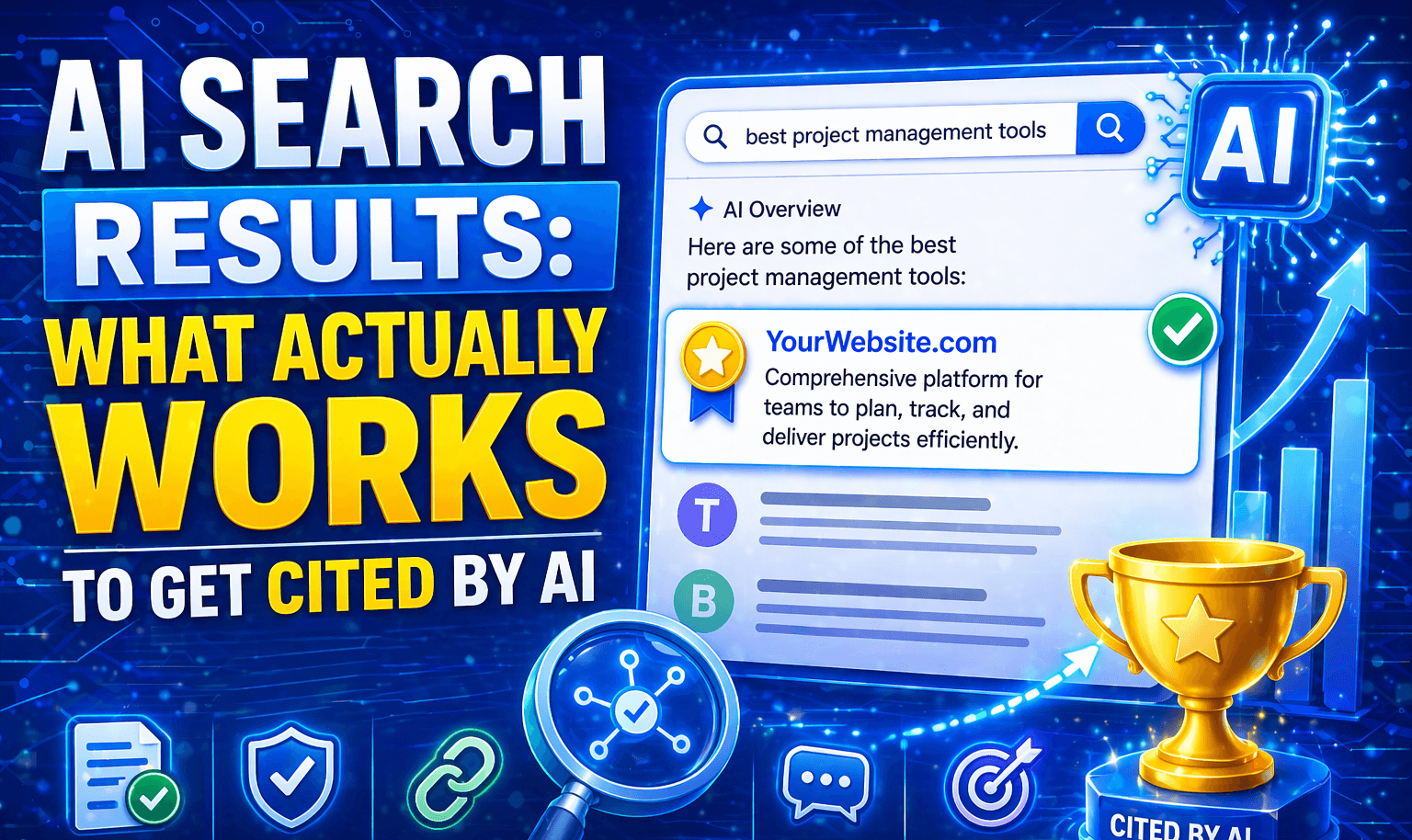
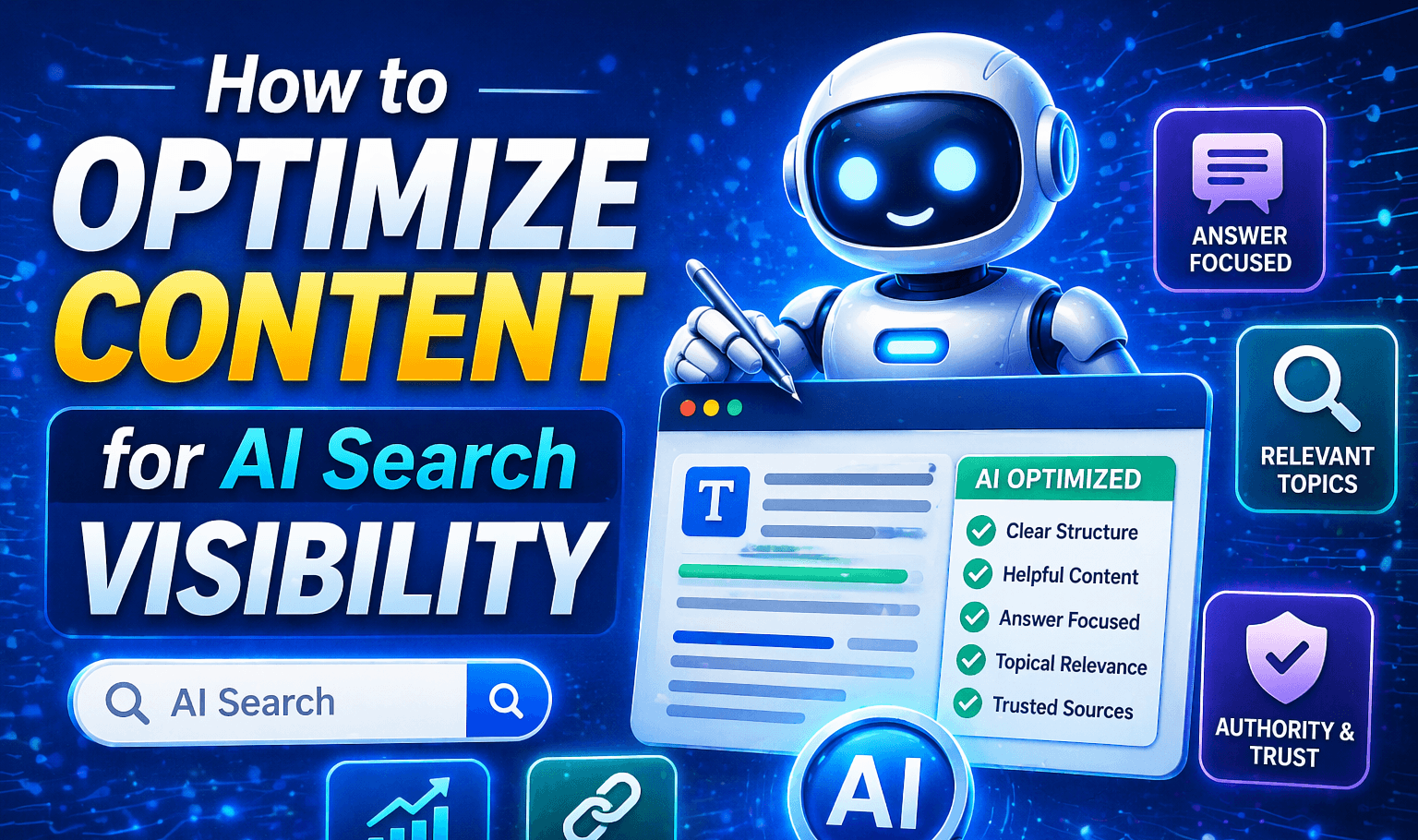
AI search engines have changed the rules of content visibility. Tools like ChatGPT Search, Perplexity AI, and Google AI Overviews no longer return a list of ten blue links and ask users to choose. They read your content, evaluate your credibility, and decide whether to use your brand as a source — all in seconds.
If you want to optimize your content for AI search visibility, you need to go beyond keywords and meta tags. You need to think about trust, structure, clarity, and authority — the four pillars that AI models use to decide whose content to surface.
This guide gives you a clear, actionable framework to do exactly that.
What is AI Search Visibility? What is AI visibility, and How to Track It?
Why Optimising for AI Search Visibility Is Different
Traditional SEO rewards pages that match keyword intent and earn backlinks whereas for AI answers The content which is clearly structured, concise and credible gets rewarded by being cited in AI answers. The shift is subtle but significant.
This requires a different approach to how you write, structure, and distribute your content.
AI models don’t browse your website the way humans do. They extract meaning, assess authority, and synthesize answers.
7 Steps to Optimize Your Content for AI Search Visibility
| Step | Action | What to Do |
| Step 1 | Audit Your Existing Content | Review all pages for question-based headings, FAQ sections, and direct answers in the first paragraph. |
| Step 2 | Rewrite Introductions | Lead every page with a 2-sentence direct answer to the main query before expanding. |
| Step 3 | Add FAQ Blocks | Add 4–6 FAQs per post using Yoast FAQ Block or RankMath FAQ Schema for rich snippet eligibility. |
| Step 4 | Strengthen Author Signals | Add author bios with credentials, link to LinkedIn, and attribute all content to real experts. |
| Step 5 | Build Off-Site Mentions | Get featured in industry blogs, podcasts, and review platforms to increase AI model brand recognition. |
| Step 6 | Add Structured Data | Implement Article, FAQPage, and HowTo schema markup so AI crawlers can parse your content easily. |
| Step 7 | Monitor & Iterate | Test your brand visibility manually on ChatGPT, Perplexity, and Google AI Overviews monthly. |
Step 1: Audit Your Existing Content
Start by reviewing your most important pages. Ask: does each page have a clear question it answers? Does the answer appear in the first paragraph? Are there subheadings structured as questions? Pages that meander or bury their main point are unlikely to be selected by AI engines. Prioritize fixing your highest-traffic pages first.
Step 2: Rewrite Introductions for Direct Answers
AI models heavily weight the first 100–150 words of a page. Rewrite every key page so that the opening paragraph directly states the answer to the primary query — before any background context, storytelling, or padding.
Step 3: Add FAQ Blocks with Schema Markup
FAQ sections are one of the most reliable ways to appear in AI-generated answers. AI engines frequently pull from FAQ content because it is already structured as a question-and-answer format. Use the Yoast FAQ Block or RankMath FAQ Schema Block in WordPress to automatically add FAQPage schema markup — this signals to AI crawlers that your content is structured and answer-ready.
Step 4: Strengthen Author and Brand Authority Signals
AI models evaluate E-E-A-T — Experience, Expertise, Authoritativeness, and Trustworthiness. Your About page, author pages, and LinkedIn presence all contribute to the trust signals that AI models use when deciding whether to cite your brand.
Step 5: Build Off-Site Brand Mentions
Backlinks still matter for traditional SEO, but AI models also factor in unlinked brand mentions. Being mentioned in product specific forums on Reddit and Quora. A consistent off-site presence is a key part of any strategy to optimize content for AI search visibility.
Step 6: Implement Structured Data (Schema Markup)
Schema markup helps AI crawlers understand the type and context of your content. For blog posts, implement Article schema, for FAQ sections, use FAQPage schema, and for how-to guides, use HowTo schema. These structured data types make it significantly easier for AI models to extract, parse, and cite your content accurately. You can add schema using the Yoast SEO plugin, RankMath, or manually via Google Tag Manager.
Step 7: Monitor Your AI Visibility Monthly
Tracking AI visibility is still an emerging practice, but you can start manually. Observe yout top 10 queries monthly on ChatGPT, Perplexity AI, and Google AI Overviews. Tools like Profound, Otterly.ai, and AthenaHQ are purpose-built to track AI search visibility at scale. Use the recommendations and result from these tools to improve t and optimize content.
AI Content Optimization: Do’s and Don’ts
| ✔ DO THIS | ✘ AVOID THIS |
| Use question-based H2/H3 headings | Stuff keywords unnaturally into paragraphs |
| Answer the query in the first 2 sentences | Bury the answer deep in the article |
| Add FAQ schema markup on every post | Ignore structured data entirely |
| Attribute content to named, credentialed authors | Publish as ‘Admin’ with no author info |
| Get brand mentions from industry publications | Focus only on backlinks and ignore mentions |
| Write in plain, direct, conversational language | Use jargon-heavy or overly academic prose |
FAQs
Optimizing content for AI search visibility means structuring and writing your content in a way that AI-powered search tools — such as Google AI Overviews, ChatGPT Search, and Perplexity AI — can easily understand, evaluate, and use as a cited source. This involves writing direct answers, using clear headings, adding FAQ schema markup, building author authority, and earning brand mentions across the web. The goal is not just to rank in a list, but to become the answer that AI engines choose to show users.
Yes — while both share a foundation in quality content and technical structure, they differ in several important ways. Traditional SEO focuses on keyword placement, backlinks, and ranking positions. AI search visibility optimization focuses on content clarity, E-E-A-T signals, structured data, and brand authority across multiple platforms. You still need strong traditional SEO as a base, but AI visibility requires additional steps like FAQ schema, conversational content structure, and off-site brand mentions that typical SEO strategies do not prioritize.
Aim to optimize all but the most used ones on priority. While each platform has slightly different retrieval methods, the same core optimisation principles — direct answers, structured content, strong authority signals — apply across all of them.
Yes — schema markup plays a meaningful role in how AI engines parse and use your content. Structured data types like FAQPage, Article, HowTo, and Organization help AI crawlers understand the context and format of your content, making it significantly easier to extract and cite accurately. FAQPage schema in particular is one of the most direct optimizations you can make, as AI engines frequently pull from FAQ-formatted content when generating answers. Implementing schema via Yoast SEO or RankMath in WordPress is straightforward and has no downside.