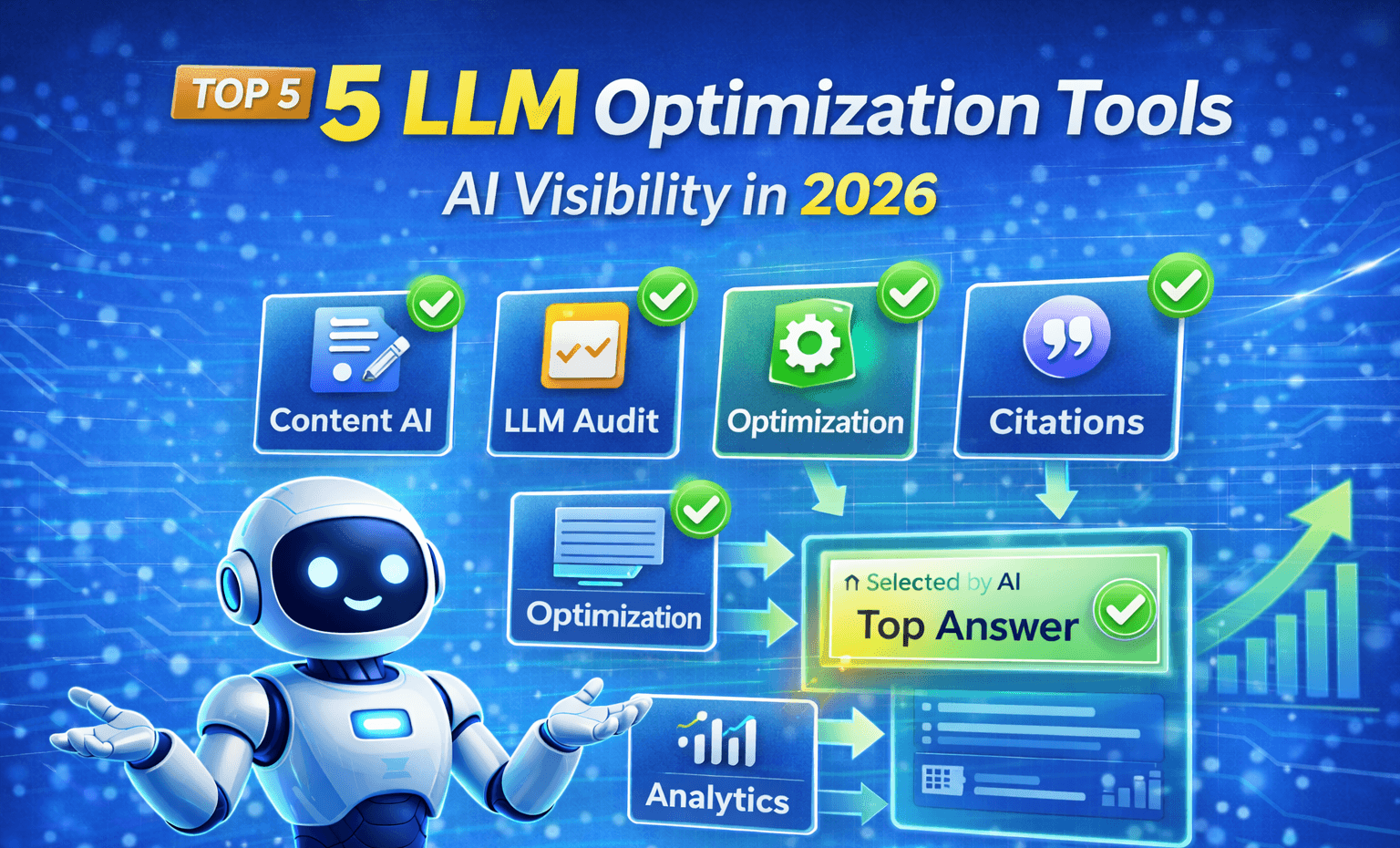
Your rankings look fine. However, when someone asks ChatGPT for a recommendation in your space, your brand is nowhere to be found.
That’s exactly the gap LLM optimization tools are built to close.
According to Ahrefs, 80% of LLM citations don’t even rank in Google’s top 100. In other words, traditional SEO tools were never built for this reality. As a result, a new category of platforms has emerged specifically to track, measure, and improve how your content performs inside AI-generated answers.
This guide covers the best LLM optimization tools in 2026 — what each does, who it’s best for, and ultimately how to choose the right one for your clients.
What to Look for in an LLM Optimization Tool
Before comparing platforms, it’s worth understanding what separates strong LLM optimization tools from dashboards that simply relabel traditional SEO metrics.
The best platforms do three things well:
- Track — monitor citation frequency and brand mentions across ChatGPT, Perplexity, Gemini, and Claude
- Diagnose — identify which competitors are being cited instead of you and why
- Improve — surface specific content gaps and optimization opportunities
Beyond that, multi-platform coverage matters more than most teams realize. Citation volumes differ by a factor of 615x across AI platforms — the same brand can be thriving on one platform and invisible on another. Therefore, any tool that only tracks one or two AI systems will give you a dangerously incomplete picture.
The Best LLM Optimization Tools in 2026
1. LLM Audit (Best for AI Citation Tracking & Brand Visibility)
LLM Audit is purpose-built for what most other tools treat as secondary. Rather than retrofitting AI tracking onto a traditional SEO platform, it is built from the ground up to monitor how your content performs inside AI-generated responses across ChatGPT, Perplexity, Gemini, and Claude.
For SEO agencies specifically, it delivers three things that matter most:
- Which pages are being cited — and which aren’t
- Which competitors are being selected over your clients
- Where specific content gaps are costing visibility
In addition to citation tracking, it monitors which AI bots are crawling your site and runs AI readiness audits, giving you a complete picture of your client’s AI search presence, not just a mention count. For agencies building LLM optimization into their service offering, it is consequently the most direct and practical tool available.
2. Profound (Best for GEO Recommendations)
Profound is far and away the best platform for GEO recommendations. Within minutes of getting started, it suggests articles you should create from scratch, existing content you should apply specific updates to, and a list of Reddit threads you should weigh in on. That said, it comes with a higher price point that may not suit smaller agencies or lean teams working within tight budgets.
3. Peec AI (Best for Competitive Gap Analysis)
Peec AI takes a competitive-intelligence approach to LLM optimisation. Rather than just showing where you’re visible, it reveals the opportunities you’re missing — topics and queries where competitors are being cited by AI systems while your brand is nowhere to be found. On the other hand, it is lighter on actionable content recommendations, so it works best when paired with a content optimization tool.
4. Otterly.AI (Best Budget Option)
Otterly.AI’s Lite plan starts at $29 per month and gets you 15 prompts tracked across ChatGPT, Google AI Overviews, Perplexity, and Microsoft Copilot. As a result, for smaller agencies testing LLM optimization before fully committing, it offers a low-risk entry point into the category without significant upfront investment.
5. Surfer SEO (Best Dual-Purpose Tool)
For teams running LLM SEO alongside traditional SEO without wanting to split their workflow, Surfer is the most practical dual-purpose tool available, combining content scoring, AI visibility tracking, and content auditing in a single platform. Consequently, it is a strong choice for agencies that want to consolidate their stack without sacrificing depth in either discipline.
How These Tools Fit Together
No single LLM optimization tool solves everything on its own. Instead, the most effective agency stacks typically combine:
- A citation tracking platform (LLM Audit, Profound, Peec AI) to measure where you stand
- A content optimization tool (Surfer SEO, Frase) to improve what you publish
- GA4 custom dimensions to track AI-referred traffic and connect visibility to revenue
Moreover, measurement infrastructure matters as much as the tools themselves. The leading tracking method uses a representative sample of 250–500 high-intent queries run daily or weekly, tracking when your brand and competitors appear as citations or mentions — enabling share of voice calculations across all AI platforms.
Without that baseline in place, neither you nor your clients can tell whether LLM optimization is actually working — or where to focus next.
The Bottom Line
The LLM optimization tools market is moving fast and getting crowded. Nevertheless, the distinction that matters most for agencies remains simple: does the tool show you where you stand, tell you why, and give you a clear path to improve?
Most tools do one of these well. The best, however, do all three.
So start with citation tracking. Understand your baseline first. Then use that data to drive content decisions that actually move the needle in AI search.
FAQs
LLM optimization tools are platforms that help you track, measure, and improve how your content performs inside AI-generated answers from tools like ChatGPT, Perplexity, Gemini, and Claude. They monitor citation frequency, brand mentions, competitor visibility, and content gaps — giving you the data needed to optimize for AI search.
Traditional SEO tools track rankings, organic traffic, and backlinks. LLM optimization tools track citation frequency, Share of Model, AI-referred traffic, and brand mentions inside AI-generated responses. The two categories measure different things and are best used together.
It depends on your priority. LLM Audit is best for citation tracking and AI readiness auditing across multiple platforms. Profound leads on GEO recommendations. Peec AI excels at competitive gap analysis. For budget-conscious agencies, Otterly.AI offers strong entry-level tracking.
For most agencies, yes. A citation tracking platform combined with a content optimization tool and GA4 custom dimensions for AI traffic attribution covers the full workflow — from measuring visibility to improving it and proving ROI to clients.
Track citation frequency (how often your brand appears in AI answers), Share of Model (your citation rate vs. competitors), and AI-referred traffic in GA4. Platforms like LLM Audit are built to monitor these metrics continuously across all major AI platforms.