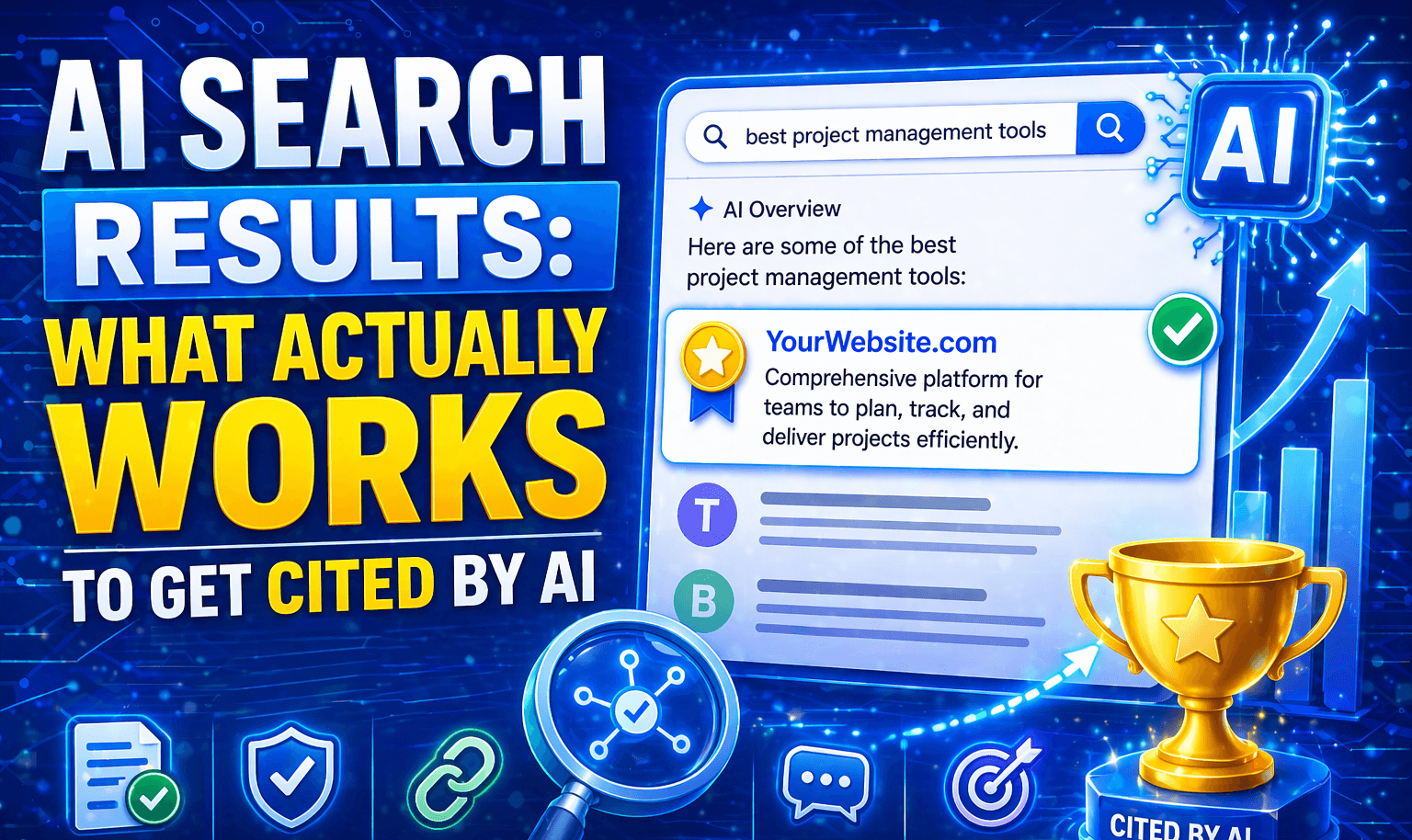

AI search is changing how people find information. Instead of clicking through links, users now get direct responses by AI LLM systems. This shift is forcing companies to rethink how they approach content, especially when it comes to AI SEO.
If your content isn’t being picked up by AI tools, it’s not just an SEO problem anymore. It’s an AI SEO problem.
To understand what works, we analyzed 1000 AI-generated answers across industries. The goal was simple: figure out what kind of content AI systems choose.
Here’s what stood out.
Clear, Direct Answers Consistently Win
The biggest takeaway is simple. AI prefers clarity.
Across every AI tool we reviewed, content that answered the question immediately was far more likely to be selected. Long introductions and keyword-heavy openings were often ignored.
This changes how you write. You can’t afford to delay the answer.
Strong content:
- Starts with a clear response
- Uses simple language
- Avoids unnecessary context
If your answer isn’t obvious in the first few lines, your AI SEO strategy will struggle.
Structure Is Critical for AI SEO
LLM systems don’t read content like humans. They scan and extract. That’s why structure plays a major role
We found that content with:
- Clear headings
- Short paragraphs
- Bullet points
- Defined sections
performed significantly better in AI for search.
For anyone investing in this, it’s one of the easiest improvements to make. Structured content is easier for AI to understand and reuse. It also makes it easier to run an audit LLM process and refine your pages over time.
Authority Still Matters, but It’s Changing
Traditional SEO rewards backlinks. Authority still matters, but in a different way. AI systems look for:

We saw that even smaller websites performed well in AI SEO when their content was focused and well explained. For any AI company or AI agency, this creates an opportunity. You don’t need to be the biggest site. You need to be the most useful. Platforms like LLM Audit help teams measure how they appear across AI tools and improve their performance.
Explanation Matters More Than Keywords in AI SEO
One of the most important shifts in is how content is evaluated. AI doesn’t just look for keywords. It looks for understanding.
Content that simply repeats phrases like AI SEO without adding value rarely gets picked. On the other hand, content that explains concepts clearly performs much better.
Good content:
- Breaks down ideas
- Uses examples
- Adds context
This is especially important for AI for content creation. Generating content is easy. Making it useful is what drives results in AI SEO.
Lists and Comparisons Perform Best
Another strong pattern we saw in AI SEO is the effectiveness of lists.
AI tools prefer formats that are easy to extract, such as:
- Numbered lists
- Step by step guides
- Comparisons
- Pros & cons
These formats align perfectly with how AI systems generate answers.
If you’re working on AI SEO, turning your content into structured lists can significantly improve your chances of being selected.
Freshness Matters Less in AI SEO
In traditional SEO, newer content often performs better. In AI SEO, that’s not always the case.
We found that older content was frequently used if it was:
- Well structured
- Easy to understand
- Comprehensive
This means your AI SEO strategy should focus less on publishing constantly and more on improving existing content. Running an LLM audit can help you identify which pages need updates.
Formatting Is Now a Core Part
Formatting is becoming one of the most important factors in AI SEO.
AI systems evaluate:
- Readability
- Layout
- Content flow
We saw many cases where content with fewer keywords still performed better because it was easier to extract.
For any AI agency or team using an AI tool, this is a major shift. Writing good content is not enough. It has to be formatted for AI consumption.
What This Means for your Strategy
After analysing 1000 AI answers, the conclusion is clear.
Success in AI SEO is not about gaming the system. It’s about making content usable.
If you want to improve your results, focus on:
- Writing direct, clear answers
- Structuring content properly
- Explaining concepts simply
- Using lists and comparisons
- Continuously improving through LLM audit processes
The way search works has changed. And AI SEO is now at the center of that change.
Thus
The shift to AI-driven answers is not temporary. It’s already shaping how users discover information.
Brands that adapt early to AI SEO will have a clear advantage. Those that don’t may find their content invisible, even if it ranks well in traditional search.
In this new landscape, the goal is simple.
Don’t just rank.
Get picked.
Related Articles
How to Get Your Content Cited by ChatGPT & Perplexity (2026 Guide for SEO Agencies)
AEO vs GEO vs SEO in 2026: What Actually Drives AI Visibility
The AI Answer Funnel: How Generative Search Decides Which Content Gets Cited
Frequently Asked Questions
AI SEO, LLMs, and visibility — explained simply
What is an LLM?
An AI LLM (Large Language Model) understands and generates human-like text.
Impact on search
Instead of showing links, AI tools generate direct answers — changing how users discover content.
Traditional SEO
Focused on ranking on Google.
AI SEO
Focused on getting included inside AI-generated answers.
Common issues
- No direct answer
- Poor structure
- Hard-to-read formatting
Solution
Use structured formatting and clear answers so AI can extract your content easily.
Definition
An LLM audit analyzes how your content performs in AI systems.
It helps you
- Track mentions
- Improve visibility
- Optimize structure
Best practices
- Start with a clear answer
- Use headings
- Keep content simple
- Use lists
Short answer
No, but it helps.
Why consider it
- Faster optimization
- Better insights
- Less trial and error