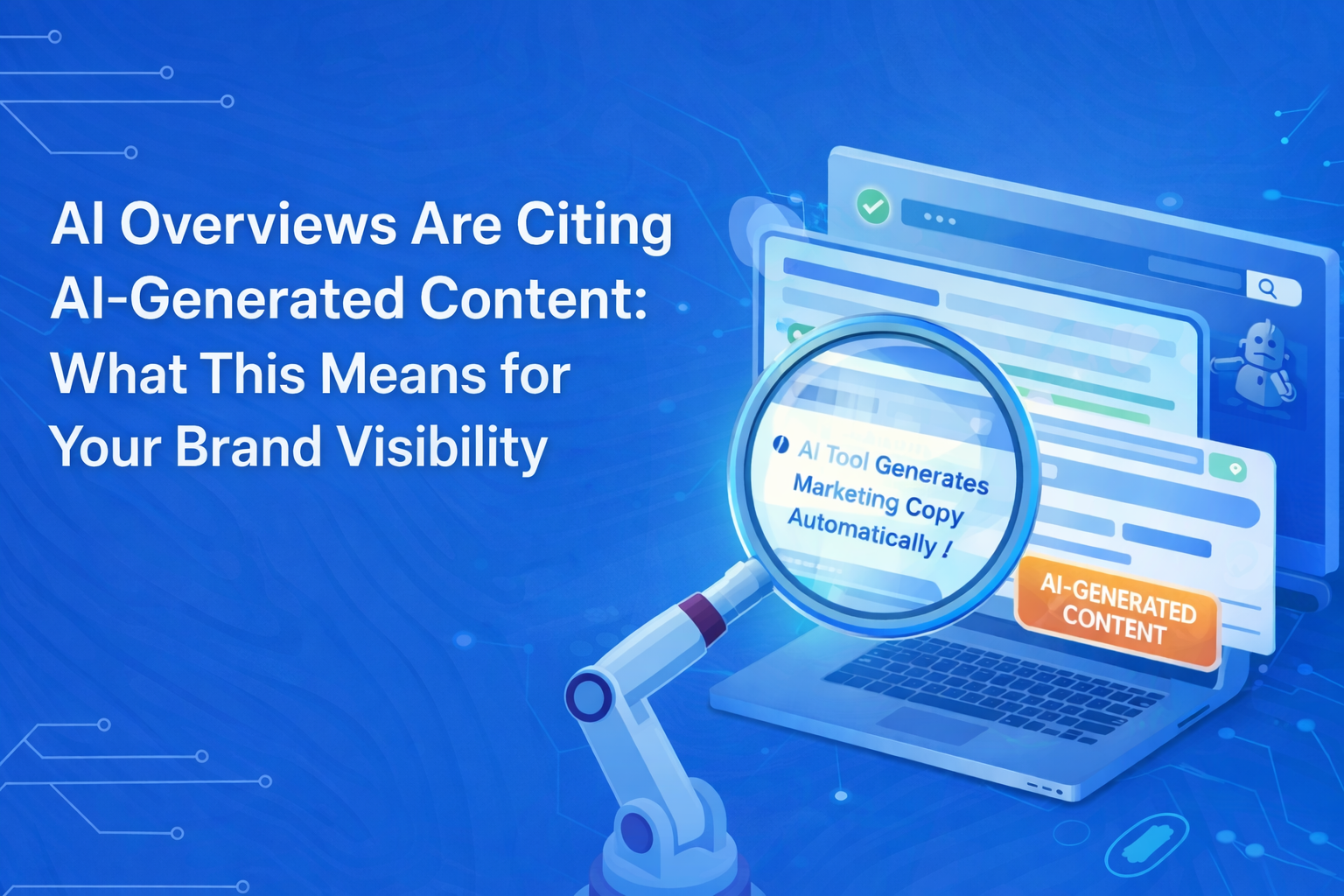
Search is shifting from link discovery to answer delivery.
With Google’s AI Overviews and conversational AI search, users increasingly receive synthesized answers instead of browsing multiple websites.
A recent large-scale analysis of AI Overview citations reveals a critical trend:
AI Overviews frequently cite pages containing AI-assisted content.
This challenges long-held assumptions about rankings, content quality, and what it takes to remain visible in AI-driven search.
AI-Assisted Content Has Become the Web Standard
Businesses, media organizations, and marketers use AI assistance for:
- drafting and outlining
- editing and refinement
- summarization
- optimization and structuring
Because AI Overviews summarize the existing web, they naturally cite AI-assisted material.
This does not mean AI-generated content is preferred.
It reflects a simple reality:
AI assistance is now part of how most digital content is produced.
As publishing accelerates, AI-assisted content continues to grow as a percentage of the web.
AI Usage Does Not Hurt Visibility
One of the most important insights from recent research is that AI usage does not negatively impact citation likelihood.
There is little correlation between AI-assisted writing and whether a page is cited.
Visibility is influenced by:
- usefulness and relevance
- clarity of explanation
- authority and credibility
- trustworthiness of the source
Search systems evaluate value to users rather than the method used to produce the content.
AI Citations Strongly Overlap With Top Search Results
AI Overviews often cite pages that already rank highly in traditional search results.
This confirms that conventional SEO signals still play a significant role in AI visibility.
However, ranking alone is no longer enough.
AI systems extract passages from pages and synthesize answers. Content must be:
- clearly structured
- easy to extract
- concise and factual
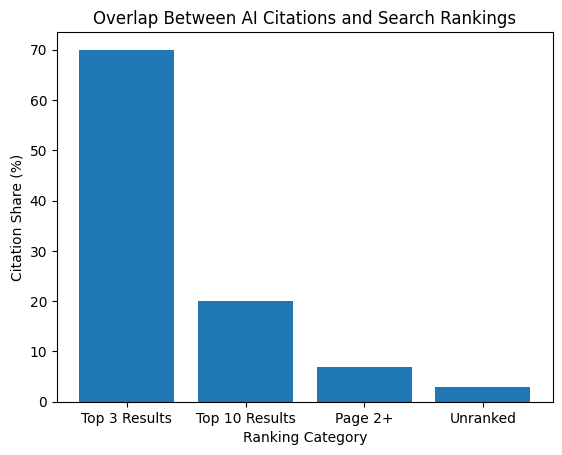
Citation overlap pattern
The chart illustrates how AI citations frequently originate from top-ranking pages, with diminishing citations from lower-ranked results.
Key takeaway: Strong rankings combined with clear structure produce the highest citation probability.
What Drives AI Citation Inclusion
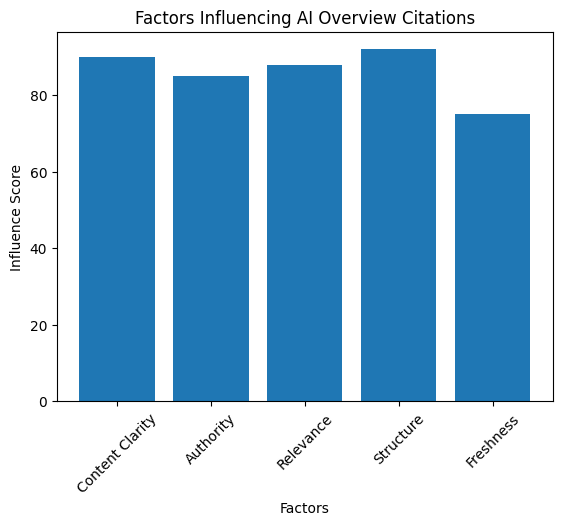
Several factors strongly influence whether content is cited.
The chart highlights the relative influence of key content quality signals.
Highest-impact factors include:
- structured, machine-readable content
- clear explanations
- relevance to query intent
- authority and trust signals
Freshness matters, but only after relevance and clarity.
The Emerging AI Content Feedback Loop
As AI-assisted publishing grows, a self-reinforcing cycle is emerging:
- AI tools assist content creation
- Search engines rank and AI systems cite that content
- AI models learn from cited material
- Future content builds on AI-generated summaries
Over time, this feedback loop may influence how knowledge evolves online.
This increases the importance of:
- original expertise
- fact-checking
- authoritative sourcing
- real-world insights
AI Visibility Is Dynamic and Frequently Changing
Unlike traditional rankings, AI Overview citations are volatile.
Sources may change due to:
- content freshness
- contextual relevance
- query variation
- algorithm updates
Being cited once does not guarantee continued inclusion. Continuous monitoring is essential.
AI Answers Are Reducing Click-Through Traffic
AI-generated answers aim to resolve user queries instantly. As a result, users often receive the information they need without visiting websites.
This shift is changing discovery behavior.
Instead of competing only for clicks, brands must compete for inclusion within AI-generated answers.
Visibility inside the answer is becoming as important as ranking on the results page.
Why AI Systems Favor Structured, Extractable Content
AI systems retrieve relevant passages and synthesize concise responses.
Content that performs well typically includes:
- clear definitions
- structured headings
- concise paragraphs
- factual statements
- logical organization
Well-structured content improves machine understanding and increases the likelihood of citation.
How to Improve Your Chances of Being Cited
Write for retrieval and synthesis
Provide clear definitions, concise explanations, and well-structured sections that AI systems can easily extract.
Build entity authority
AI systems rely on entity recognition and trust signals. Consistent brand mentions, authoritative citations, and industry references strengthen credibility.
Use semantic structure
Schema markup, FAQs, and clear formatting improve machine readability and content understanding.
Combine AI efficiency with human expertise
AI assistance is common, but original insights, expert analysis, and real-world experience differentiate trusted sources.
Monitor AI visibility
Tracking citations, mentions, and competitor presence is essential in AI-driven search environments.
Tools such as LLMAudit align directly with these emerging monitoring needs.
The Future of Search Is AI-First
Search is evolving toward:
- answers instead of lists of links
- entity trust instead of link authority
- citations instead of rankings
- instant resolution instead of browsing
If your brand is not cited in AI answers, it may not be seen by users who never click through to websites.
Final Thoughts
AI Overviews citing AI-assisted content is not a flaw — it is a reflection of how the modern web is created.
In this new landscape, success will not be determined by publishing the most content, but by building:
- authority
- clarity
- trust
- machine-readable structure
As AI-driven discovery continues to evolve, visibility inside answers is becoming the new frontier of search.
Brands should monitor their presence in AI-generated answers with tools like:
Ahrefs – https://ahrefs.com
LLMAudit.ai – https://www.llmaudit.ai